
April 28, 2026 - PBS News Hour full episode
4/28/2026 | 57m 46sVideo has Closed Captions
April 28, 2026 - PBS News Hour full episode
April 28, 2026 - PBS News Hour full episode
Problems playing video? | Closed Captioning Feedback
Problems playing video? | Closed Captioning Feedback
Major corporate funding for the PBS News Hour is provided by BDO, BNSF, Consumer Cellular, American Cruise Lines, and Raymond James. Funding for the PBS NewsHour Weekend is provided by...
April 28, 2026 - PBS News Hour full episode
4/28/2026 | 57m 46sVideo has Closed Captions
April 28, 2026 - PBS News Hour full episode
Problems playing video? | Closed Captioning Feedback
How to Watch PBS News Hour
PBS News Hour is available to stream on pbs.org and the free PBS App, available on iPhone, Apple TV, Android TV, Android smartphones, Amazon Fire TV, Amazon Fire Tablet, Roku, Samsung Smart TV, LG TV, and Vizio.
Providing Support for PBS.org
Learn Moreabout PBS online sponsorshipAMNA NAWAZ: Good evening.
I'm Amna Nawaz.
GEOFF BENNETT: And I'm Geoff Bennett.
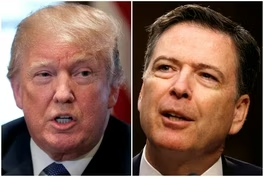
On the "News Hour" tonight: Former FBI Director James Comey is indicted again, this time over a social media post the Trump administration says crossed a line.
AMNA NAWAZ: The cost of oil rises to its highest level since the start of the war with Iran, as the Strait of Hormuz remains closed.
GEOFF BENNETT: And King Charles delivers a message of unity and peace to Congress during a time of tense relations with the U.S.
KING CHARLES III, United Kingdom: Whatever our differences, whatever disagreements we may have, we stand united in our commitment to uphold democracy.
(BREAK) AMNA NAWAZ: Welcome to the "News Hour."
Former FBI Director James Comey has once again been indicted by the Department of Justice.
It's the second time the Trump administration has attempted to prosecute him.
GEOFF BENNETT: The indictment is connected to a post Comey shared last year on social media of shells spelling out the numbers 8647.
The Justice Department argues that post is a death threat.
TODD BLANCHE, Acting U.S.
Attorney General: While this case is unique and this indictment stands out because of the name of the defendant, his alleged conduct is the same kind of conduct that we will never tolerate and that we will always investigate and regularly prosecute.
GEOFF BENNETT: Eighty-six, when used as slang, generally means to get rid of something.
And Mr.
Trump is the 47th president.
The DOJ previously tried to indict Comey last year, accusing him of lying to Congress.
That case was dismissed by a federal judge last year on procedural grounds.
For more on today's announcement, we're joined now by our justice correspondent, Ali Rogin.
So, Ali, what is James Comey accused of specifically in this indictment?
ALI ROGIN: This grand jury accuses Comey of two felony counts of threatening the president's life, which come with a maximum prison sentence of 10 years.
There was also a warrant issued for his arrest.
And just a few minutes ago, Comey issued a response via video.
JAMES COMEY, Former FBI Director: Well, they're back, this time about a picture of seashells on a North Carolina beach a year ago.
And this won't be the end of it.
But nothing has changed with me.
I'm still innocent.
I'm still not afraid and I still believe in the independent federal judiciary.
So let's go.
ALI ROGIN: And as to those allegations, Comey said at the time that he was not aware the phrase 86 carried violent connotations and he subsequently took the post down.
GEOFF BENNETT: As he says, this happened a year ago.
So why now?
ALI ROGIN: Attorney General Todd -- acting Attorney General Todd Blanche said that this investigation has been ongoing for the past year and this is just how the timing worked out.
It is worth noting, however, that the president has expressed frustration with the pace of efforts to prosecute his political adversaries.
And it's one of the reasons why Attorney General Pam Bondi is reported to have lost her job.
And since becoming acting, Attorney General Todd Blanche has taken several big steps in putting the focus back on President Trump's perceived political enemies, including former CIA Director John Brennan and former President Joe Biden.
GEOFF BENNETT: Based on your reporting, Ali, how difficult will it be for the DOJ to make this case against Comey?
ALI ROGIN: Prosecutors are going to have a high bar to clear that Comey knowingly threatened the president.
And the Supreme Court made that high bar explicit in a 2023 opinion, where they said that a person must have a subjective understanding that their statement could be interpreted as threatening.
Otherwise, that speech is protected under the First Amendment.
And, as I just said, Comey said at the time that he was unaware that the phrase 86 had violent connotations.
GEOFF BENNETT: Could this case open the door to others?
ALI ROGIN: It certainly could.
Blanche did say today that every case is different, the facts of each one are different.
But Comey is not the first person to use this phrase, and he's likely not going to be the last.
It's shown up at rallies, on signs, on T-shirts.
Michigan Governor Gretchen Whitmer notably had it displayed, were the letters 8645 on her desk during President Trump's first term.
But Geoff, the statute of limitations on these cases is five years.
So any forthcoming cases stemming from this one would likely have to be related to President Trump's second term.
GEOFF BENNETT: Ali Rogin, thanks again for this reporting.
ALI ROGIN: You bet.
AMNA NAWAZ: There seems to be little movement on the resumption of talks between the U.S.
and Iran to end the war that the Americans launched alongside Israel over two months ago.
There's also almost no movement through the Strait of Hormuz, the vital bottleneck that's essentially cut off 20 percent of the world's oil and gas supply.
Last week saw the fewest crossings since the war began.
Today, the United Arab Emirates announced it will leave OPEC, the cartel that's largely controlled global oil supplies for decades, leading to more uncertainty and questions about when the financial pain will stop.
For perspective, we're joined now by Karen Young, a political economist and senior research scholar at Columbia University.
Great to see you.
Thanks for being here.
KAREN YOUNG, Columbia University: Thanks for having me.
AMNA NAWAZ: So, the UAE has been rumored to want to leave OPEC for some time now.
Why now?
Was the war in Iran the last straw?
KAREN YOUNG: No, I think actually this timing is probably the least disruptive, because this doesn't change volumes that are going out tomorrow.
The UAE can't increase its production and get to market any faster because the Strait of Hormuz is blocked, and they're at capacity for the oil that's flowing through the pipeline through Fujairah.
So it doesn't change anything from a market and supply perspective.
But, yes, it's true, within OPEC, the UAE had the most stringent quota based on what it had capacity to produce, and its quota was much smaller.
So it's been a point of tension, particularly with neighbor Saudi Arabia, for quite some time now.
AMNA NAWAZ: The UAE energy minister actually gave an interview to CNN International earlier today to try to explain their decision.
Here's part of what he had to say.
SUHAIL AL MAZROUEI, Minister of Energy, United Arab Emirates: We are totally at an uncomfortable level of inventories.
That would require additional resources to fulfill it.
So the world before the Strait of Hormuz is different than the world today.
AMNA NAWAZ: He was, of course, talking about global inventories and shortages there, but he seems to be saying leaving OPEC will allow producers to ramp up production and fill the shortages.
Will it?
KAREN YOUNG: Once the Strait of Hormuz is open, yes, and it would be helpful to see an increase in production, particularly as we have to refill the shortages that have been part of the last two months.
But it won't be an immediate fix.
And so I think that the UAE motivation is that they have wanted to expand production.
They have invested about $150 billion into their oil and gas resources, and they want to produce more gas with the oil.
So, this is something that nobody's really talking about.
The more oil that they drill offshore, there's gas associated with that oil.
And there's a big demand for gas inside the UAE for electricity generation.
So this falls in line with some of their domestic industrial ambitions as well.
AMNA NAWAZ: This is about broader ambitions for the UAE than beyond just oil production.
KAREN YOUNG: That's right.
It's for electricity generation for A.I., for example.
It's about their diversification agenda inside the country and able to make decisions of their partnerships, who are their consumers of oil and gas and renewables, how do they get to them.
This matters a lot, I think, for their ability to supply China with oil and perhaps gas as export in the future.
AMNA NAWAZ: Meanwhile, they are as hamstrung as anyone else to get out oil supply while that strait is closed.
Talks with Iran appear to be a stalemate, no sign of the strait reopening any time soon.
How do you look at that right now in terms of where global oil supplies are?
KAREN YOUNG: So this remains the largest supply shock to global oil markets and gas markets we have ever experienced.
And as we get farther along into this crisis, what's happening is that we don't have that oil getting to market, about 16 million barrels a day that's absent from the Strait of Hormuz.
But then countries are drawing down on their inventories.
This could be strategic stockpiles or what firms and commercial entities hold.
We're starting to draw into those inventories.
And, as we do, that means that the price has to climb, right, because it's not being replaced, it's not being refilled.
So we're going to get more price pressure as we have this kind of supply shortage.
And, eventually, there will be a reaction to that.
And that's what we call demand destruction.
And that's where we start to feel the pinch, not just in transportation, but in the fuels that are associated made from oil, anything like naphtha or LPG, things that go into plastics, the petrochemical feedstocks, which is going to make everything we buy and use basically more expensive.
AMNA NAWAZ: So let's be more clear on that from the consumer's point of view.
Gas prices just hit a four-year high, right?
We know consumers are already paying elevated prices, not just at the pump, but in terms of airline tickets and the food prices that they pay, in terms of the cost of shipping goods as well.
What should they expect to see in the weeks and months ahead?
KAREN YOUNG: Gas prices are going to be higher, so particularly in transportation fuels.
That's gasoline, that's jet fuel, that's fuel for shipping, marine fuel, diesel, anything that's used in a large construction project or in mining.
All of those things become more costly.
AMNA NAWAZ: And even if the strait was open tomorrow, there's a downstream impact, right?
What are we looking at?
KAREN YOUNG: That's right.
One of the issues is that in order to restart the wells that have been shut in could take several months.
This could take three to four months in the case of Kuwait, perhaps longer in Iraq.
So, getting back to normal is not a one-day thing.
First, it's getting ships into the Strait of Hormuz, having them load, having them then exit safely, and getting that volume of traffic that we had before February 28.
And we're a long way away from that, particularly if the Strait of Hormuz has mines and we require military escorts of ships.
AMNA NAWAZ: Getting back to the UAE here, the decision they made here to leave OPEC seemed to say they put their national interests ahead of being part of this legacy institution, which has controlled the global supply for 60 years now, more than that.
How do you look at that decision?
Is this reducing the impact and influence of OPEC overall?
KAREN YOUNG: Well, it's not uncommon.
Countries can leave OPEC and rejoin.
Ecuador has done that.
Qatar left OPEC.
They're more of a gas supplier than an oil supplier anyway.
Angola left OPEC.
So it doesn't rule out the potential of cooperation or even rejoining.
But, yes, it is a signal of independence politically and economically that the UAE is thinking about the future after this war and the independence and the kind of oil production, gas production, energy production and industrial growth they want to have at home.
AMNA NAWAZ: Karen Young, always appreciate your time and insights.
Good to see you here.
Thank you so much.
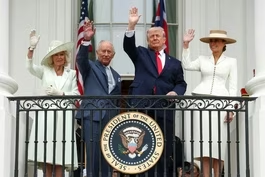
GEOFF BENNETT: The king and queen of England were received with high diplomatic fanfare this morning at the White House, day two of the royal visit.
AMNA NAWAZ: This afternoon, King Charles became just the second monarch to address Congress in this, the 250th anniversary of America declaring independence from the king's five-times great-grandfather King George III.
Nick Schifrin reports.
NICK SCHIFRIN: Today, at a rainy White House, there was pomp and pageantry, preening and praising.
And after this military ceremony, the U.S.'
highest diplomatic honor, President Trump did what Brits do when things might get a little bit awkward, talk about the weather.
DONALD TRUMP, President of the United States: What a beautiful British day this is.
NICK SCHIFRIN: President Trump is the son of a Scott and today recalled his mother's fondness for everything royal, especially a man Trump today called a blessing.
DONALD TRUMP: I also remember her saying very clearly: "Charles, look, young Charles, he's so cute."
DONALD TRUMP: My mother.
My mother had a crush on Charles.
DONALD TRUMP: Can you believe it?
Amazing how - - I wonder what she's thinking right now.
NICK SCHIFRIN: And President Trump celebrated what he called the free world forged together 80 years ago by President Franklin Roosevelt and British Prime Minister Winston Churchill.
DONALD TRUMP: That understanding of our nation's unique bond and role in history is the essence of our special relationship, and we hope it will always remain that way.
This is not Winston Churchill that we're dealing with.
NICK SCHIFRIN: But it was only last month President Trump disparaged the special relationship, after the U.K.
declined U.S.
requests to use British bases to attack Iran.
DONALD TRUMP: And I'm not happy.
By the way, I'm not happy with the U.K.
either.
NICK SCHIFRIN: And so, today, a king who is officially apolitical met in the Oval Office with the bust of Churchill over the president's shoulder flanked by both countries' top diplomats and officials for a moment the British government hopes can help reset the relationship.
But European concern runs deeper.
Today, The Financial Times published a February recording of British Ambassador to the U.S.
Christian Turner questioning just how much the U.K.
can still rely on the U.S.
CHRISTIAN TURNER, British Ambassador to the United States: Special relationship is a phrase I try not utter, because it's quite nostalgic.
It's quite backwards-working, and it has a lot of sort of baggage about it.
I think there is probably one country that has a special relationship with the United States.
And that's probably Israel, when Europe can't just rely on a U.S.
security umbrella.
So the relationship will carry on, if you want, being special, but I see it's going to have be different.
NICK SCHIFRIN: Different because President Trump's questioning European sovereignty and doubting the U.S.'
commitment to NATO has led to European doubts the U.S.
will keep providing Europe security, even if in a statement today the British government called Turner's words -- quote -- "private informal comments made to a group of U.K.
high school students.
They are certainly not any reflection of the U.K.
government's position."
KING CHARLES III, United Kingdom: America's words carry weight and meaning, as they have since independence.
The actions of this great nation matter even more.
NICK SCHIFRIN: And so, this afternoon, for only the second time in almost exactly 250 years of separated history, a British monarch addressed a joint meeting of Congress with an appeal to unity.
KING CHARLES III: Whatever our differences, whatever disagreements we may have, we stand united in our commitment to uphold democracy, to protect all our people from harm and to salute the courage of those who daily risk their lives in the service of our countries.
NICK SCHIFRIN: That line an echo of the first and before today only British monarch to address a joint session of Congress, Charles' mother, Queen Elizabeth II, 35 years ago.
QUEEN ELIZABETH II, United Kingdom: The best progress is made when Europeans and Americans act in concert.
KING CHARLES III: It is an era that is in many ways more volatile and more dangerous than the world to which my late mother spoke.
NICK SCHIFRIN: But even if in a soothing baritone, King Charles did not avoid drawing British distinction in his British way with the Trump administration.
KING CHARLES III: We must also reflect on our shared responsibility to safeguard nature.
That same unyielding resolve is needed for the defense of Ukraine and her most courageous people.
We answered the call together, as our people have done so for more than a century, shoulder to shoulder.
NICK SCHIFRIN: But, today, that implicit criticism did not dampen the president riding royal coattails, the White House posting this photo with the caption: "Two kings."
But what King Charles did not mention today, his brother, Andrew Mountbatten-Windsor, who has been stripped of his titles for his relationship with Jeffrey Epstein and Epstein's victims.
And the king will not meet those victims during this trip to the U.S.
Today, the family of Virginia Giuffre, a victim of Epstein who died last year, said both the king and President Trump should have delivered a message that they stand with survivors.
The king's lawyers told Representative Ro Khanna the king supported all victims of abuse, but because of ongoing police inquiries, he was unable to meet with those survivors.
GEOFF BENNETT: We start today's other headlines in Minnesota, where federal agents carried out more than 20 search warrants as part of an ongoing fraud investigation by the Trump administration.
Agents were seen entering childcare centers this morning like this one outside Minneapolis.
The White House has criticized Governor Tim Walz, a Democrat, over his handling of fraud in the state.
But Walz welcomed the raids, posting on social media: "If you commit fraud in Minnesota, you're going to get caught.
Joint investigations work and securing justice depends on it."
Officials say today's operation was not related to a federal immigration crackdown that led to the deaths of two protesters earlier this year.
A former adviser to Dr.
Anthony Fauci at the National Institutes of Health has been indicted by a federal grand jury in Maryland for conspiring to hide records related to the COVID pandemic.
Dr.
David Morens is accused of obstruction of justice and conspiracy for allegedly using a personal e-mail account to conceal research related to the origins of the disease.
His lawyer declined to comment.
The indictment is seen as a win for the Trump administration, which has been critical of the nation's research community over its handling of COVID's origins.
Dr.
Fauci himself is not accused of wrongdoing in the case.
In Georgia, state officials say recent rainfall is helping efforts to tame two massive fires, but more work needs to be done to bring them under control.
A statewide drought has led to an unprecedented fire season with more than 700 blazes in a 30-day period.
Governor Brian Kemp toured the affected areas today and warned that Georgia isn't, as he put it, out of the woods just yet.
GOV.
BRIAN KEMP (R-GA): I feel better today than I did Sunday.
And the rain we got, especially on the Highway 82 Fire, was very helpful.
We are doing everything that we can to try to get people where they can get back to their homes, make sure they're protected.
And as soon as we can do that, we will.
GEOFF BENNETT: As Georgia welcomes the rain, other states are bracing for more of it.
Severe thunderstorms threaten to bring hail and possibly tornadoes to parts of Texas, Mississippi and Tennessee that have already endured punishing storms in recent days.
The U.S.
State Department is rolling out a new limited-edition passport that includes a picture of President Trump.
The State Department posted what it called a sneak peek on social media.
It shows the president's image on the inside cover with his signature and gold lettering at the bottom.
The back cover shows a more traditional scene of the Declaration of Independence.
The release is part of the commemorations marking the 250th anniversary of American independence.
It's also the latest effort to put Mr.
Trump's mark on the nation, which includes his images on government buildings, his name on what was the Kennedy Center, and a planned arch in Washington, among others.
Ukraine says it shot down more than 33,000 Russian drones in March.
That's the most in a single month since Russia's invasion more than four years ago.
Ukraine has been ramping up its drone capabilities in response to Russia's relentless aerial attacks and increasingly taking the fight back across the border.
Officials said today Ukrainian forces can now strike much deeper inside Russia than they could at the start of the war.
Earlier this month, Moscow accused European nations of expanding drone support to Kyiv, prompting a warning today from Russia's defense minister.
ANDREI BELOUSOV, Russian Defense Minister (through translator): This sort of action facilitates the sharp escalation of the military and political situation across the entire European continent and can have unpredictable consequences.
GEOFF BENNETT: Just yesterday, Poland's prime minister announced that his country will partner with Ukraine to manufacture what he described as a drone armada.
Poland and Russia share a border.
And Russia has violated Polish airspace on a number of occasions since the Ukraine war started.
On Wall Street today, stocks ended lower following that latest spike in oil prices.
The Dow Jones industrial average gave back just 25 points on the day.
The Nasdaq fell more than 200 points.
The S&P 500 also closed in negative territory.
Still to come on the "News Hour": recent shootings are again raising concerns about gun violence in the U.S.
; military families sound the alarm about the persistent problem of toxic mold in service members' housing; and actors Tessa Thompson and Adrien Brody discuss their Broadway debut.
BREAK) The Federal Communications Commission is ramping up the pressure on ABC and Disney by threatening to strip broadcasters of their station licenses.
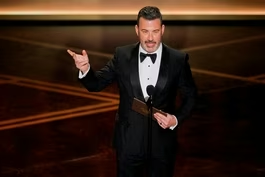
The FCC says the review of the licenses is tied to Disney's DEI initiatives, but it's widely seen as retaliation in the ongoing battle between President Trump and ABC and its late-night host Jimmy Kimmel.
On his show last week, Kimmel parodied Saturday's White House Correspondents' Dinner in advance, delivering a mock roast, which included this joke about the Trumps: JIMMY KIMMEL, Host, "Jimmy Kimmel Live": And, of course, our first lady, Melania, is here.
Look at -- well, it's so beautiful.
Mrs.
Trump, you have a glow like an expectant widow.
GEOFF BENNETT: Kimmel later said it was a joke about their age difference.
But following the shooting at the dinner, the first lady yesterday wrote a post on X criticizing Kimmel, saying he -- quote -- "deepens the political sickness in America and that people like Kimmel shouldn't have the opportunity to enter our homes each evening to spread hate."
That was echoed by the president, who said Disney should fire Kimmel, and then reiterated by Press Secretary Karoline Leavitt.
KAROLINE LEAVITT, White House Press Secretary: Just two days prior to the shooting, ABC's late-night host Jimmy Kimmel disgustingly called first lady Melania Trump an expectant widow.
Who in their right minds says a wife would be glowing over the potential murder of her beloved husband?
This kind of rhetoric about the president, the first lady and his supporters is completely deranged and it's unbelievable that the American people are consuming it night after night after night.
GEOFF BENNETT: For his part, Kimmel said last night that this is all a matter of free speech.
For more on all of this, we're joined now by CNN's chief media analyst, Brian Stelter, who's outside ABC's New York headquarters.
Brian, thanks for making time for us.
So, the FCC says the timing of this license review coming within 24 hours of President Trump criticizing Kimmel is coincidental.
How credible is that claim, given the sequence of events?
BRIAN STELTER, CNN: Well, I don't know any legal experts or FCC experts who believe that claim.
It is true there's been an open investigation of Disney involving the company's diversity practices, DEI programs.
That's been going on for quite some time.
And it is true that, just last week, Disney turned over some documents in that probe.
So that's going to give the Trump-aligned FCC chairman, Brendan Carr, the excuse or the rationale or the story that he can tell publicly about why this is happening.
But, listen, we have heard President Trump threaten local TV station licenses for more than a year now.
This is the first concrete action that the government's taking to follow up on those threats.
He is calling in -- Carr is calling in these licenses for early renewal, which is a way to challenge the licensees.
And it's going to cause a protracted legal battle, but the action today is being called by the lone Democrat on the FCC, Anna Gomez -- quote -- "the most egregious action the FCC has taken in violation of the First Amendment to date."
She basically says Brendan Carr heard Trump's complaint, and, today, he's answering the president's call.
GEOFF BENNETT: The last time the FCC revoked a broadcast license related to a station's programming was in 1969.
There was a station in Jackson, Mississippi, which defended segregation on the air.
What are the realistic outcomes here?
Are we talking fines, conditions on licenses, or something more severe?
BRIAN STELTER: I think the process is mostly the punishment here.
It is unlikely that ABC would have its station licenses in eight cities where it owns stations, it's unlikely those would actually be revoked.
And if the FCC does try to revoke those licenses, again, it'll cause a protracted legal battle.
ABC can appeal.
And there's lots of legal rationale or legal history to believe that ABC would win.
But here's the thing.
Disney would have to be willing to fight.
That's the big question here.
Will Disney fight it out in court?
Now, today, the company came out with a statement that says it believes it's confident it will prevail and it did cite the First Amendment.
And my sources at Disney say they're willing to fight this First Amendment battle.
But will that be true over a period of months and maybe even years?
We don't know.
And, by the way, this might not just be about Kimmel or about DEI programs, for that matter.
In this building is the ABC daytime talk show "The View."
And FCC officials have also been scrutinizing "The View" over alleged equal time violations.
So, basically, if you're the head of Disney, you have government pressure from multiple directions right now.
This is a big test for the new CEO, Josh D'Amaro, who just took over for Bob Iger six weeks ago.
But so far, at least, my sources say he is willing to stiffen his spine and push back, because this sure looks like a First Amendment clash.
GEOFF BENNETT: And how are other broadcasters watching all of this, Brian, based on your reporting?
BRIAN STELTER: Well, right now, we're talking about a handful of big companies, and, of course, PBS as well, broadcasters that are licensed by the federal government.
Channels like the one I work, CNN, they're not licensed by the federal government.
But this action that we are seeing from the government, it does potentially have a chilling effect all across the mainstream media.
But I am heartened to say that, when we have seen these other First Amendment stress tests in America during Trump 2.0, America has been passing the test, maybe not with A-plus grade.
But remember last September, when Kimmel was briefly pulled off the air when there was another controversy?
And then he was brought back less than a week later.
That's an example of Disney recognizing that it has to defend its stars and defend the right of comedians and, yes, journalists too, to speak freely.
Normally, gosh, when we cover political leaders trying to silence a comedian, we're usually talking about authoritarian regimes.
But, right now, it's happening here in America.
GEOFF BENNETT: CNN chief media analyst Brian Stelter, good to see you.
Thanks for being with us.
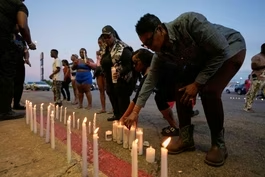
AMNA NAWAZ: Gun violence continues to impact communities across the country on a daily basis, often in ways that don't make the news, but create lifelong consequences for victims, their families, even entire neighborhoods.
The normalization of shootings, fueled in part by easy access to guns, has created a persistent public health crisis.
William Brangham tells us more.
WILLIAM BRANGHAM: Think of the most recent shootings that made national news, the foiled attack on President Trump this weekend, for sure, but what about the horrible murder of eight children two Sundays ago in Louisiana?
That received far less attention.
Or what about the mass shooting in Indiana three days ago, where nine people were shot?
According to the Gun Violence Archive, while shootings are going down, in just the last 72 hours, there have been over 175 different shootings in this country where someone was shot or killed.
That is just three days' worth.
For more on how we reckon with this ongoing toll, we are joined again by Dr.
Emmy Betz.
She's an E.R.
doctor and associate dean for centers and institutes at the University of Colorado Anschutz School of Medicine and director of the Firearm Injury Prevention Initiative.
Dr.
Betz, so nice to see you again.
Do you think we have just gotten desensitized to this ongoing toll of gun violence?
DR.
EMMY BETZ, Director, Firearm Injury Prevention Initiative: I think, to some extent we have, I think especially given the kind of other noise that we're all dealing with and the chaotic world we're living in.
But I think it's really important that we not settle for this as a new normal.
It doesn't have to be this way, and I think it's important that we keep having these conversations, so that we can find a better future.
WILLIAM BRANGHAM: And I know you think it's important to remind people that, as I mentioned, shootings, while still horrendous, are going down.
DR.
EMMY BETZ: Right.
I think it's important we talk about that gun violence as a problem is big and complex, and it's not just mass shootings.
We know the daily toll of violence, the majority of gun deaths in this country are from suicide.
That's been a persistent problem, and we're not seeing improvement, despite a lot of promising work.
But where we are seeing improvement is in homicides.
So, gun murders are at historic lows in terms of decreases in rates and numbers, for the past three years, and that's really something to celebrate.
WILLIAM BRANGHAM: Do you have a sense, do other researchers have a sense as to why those are going down?
DR.
EMMY BETZ: So there's not a single answer, and I think this is one of the things that's both complicated about these discussions, but also should bring us hope.
There's not going to be one perfect fix to this problem.
There's not one law, there's not one policing approach or one intervention we need to put in place.
It takes a lot of pieces working together.
So we have seen a decrease in murder rates because of things like wraparound and comprehensive intervention programs to get at those upstream risk factors related to socioeconomic stress, job stress, et cetera.
We're seeing differences in policing approaches.
All of these things that can work together, even things like neighborhood design, better lighting, better green spaces, can have an impact in helping reduce violence in the community, and we see that murder rate go down.
We are, though, still having persistent problems related to violence within homes.
So I mentioned suicide, but we also really need to be talking about domestic violence, and domestic violence and suicide are often closely linked, as we have seen in recent cases.
WILLIAM BRANGHAM: As you mentioned, we often, in the media, focus on big shootings, the ones with the really grim death tolls.
But that often overlooks the much larger number of people who survive shootings, either shootings of themselves or of their loved ones, and who then often have to reckon with that trauma for years, maybe the rest of their lives.
DR.
EMMY BETZ: No, it's very true.
We talk a lot about the deaths, because, in some ways, those are easier to count.
But we do need to recognize the bigger toll that it's having on all of us as survivors and as a society where we see people changing behavior because of fear of mass shootings and so forth.
And we need to recognize, at the individual level, people can have complex and differing responses after trauma.
Somebody might seem fine right away and then have symptoms develop later.
And it's important to know, if you have been through any kind of trauma, if you have been in a mass shooting situation, or if you have lost a loved one to violence, that there are effective and evidence-based treatments out there, and there's help available.
WILLIAM BRANGHAM: Do you think that, in part, we don't talk about suicides and domestic violence in their relation to gun violence because, in some ways, those are considered taboo topics, things that are just for, that's someone's internal problem, that's not a national problem?
DR.
EMMY BETZ: I think so.
And I think it's something, we need to continue to fight against that stigma.
I think, during the COVID pandemic, we saw a lot of increased awareness about how sort of the roller coaster of life brings ups and downs for all of us.
And when we think about suicide and firearm suicide, in particular, we know it's that when someone's in a bad moment.
So maybe it's mental illness, but maybe it's also losing a job, getting divorced, kind of having all of those bad things in life hit you at once.
If a lethal method like a gun is available, the person is much less likely to survive.
So it's not that the gun causes the suicide, but it's that, in that moment, it's less safe for someone if they're in an environment with a gun.
It's very much like a designated driver at the bar who helps a friend get home while they're impaired.
In the same way, we need to be thinking about how do we reduce access to firearms for people going through difficult times who might be at suicide risk, elevated risk of suicide, but who might also -- maybe they're dealing with anger issues and going through bad divorce and might be at risk of hurting their partner or their family, for example?
So that's where, again, it's not that the gun is causing the problem, but it's a key factor that leads to fatal outcomes.
WILLIAM BRANGHAM: Dr.
Emmy Betz at the University of Colorado Anschutz School of Medicine, always great to hear from you.
Thank you so much.
DR.
EMMY BETZ: Thank you so much.
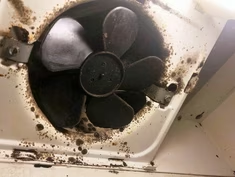
AMNA NAWAZ: Military families are sounding the alarm about the presence of toxic mold in military housing.
It's an issue that's long been making service members and their families sick.
Stephanie Sy has our report on the ongoing problem and what is and isn't being done to address it.
STEPHANIE SY: The Pentagon acknowledged last year that there are serious health concerns related to base housing conditions, but families say the problems persist.
Bills introduced in the House and Senate to address the problems so far haven't progressed.
There are a host of reasons why military families may be disproportionately at risk for the ill effects of untreated mold infestations, and we will get to that in a moment.
But, first, hear what several families told us about how they're affected.
ERICA THOMPSON, Military Spouse: I'm Erica Thompson, and I'm a 22-year military spouse.
My husband is in the Air National Guard.
We moved into military housing.
And, right away, we noticed some issues with the HVAC system, and so we put in the proper service calls.
They came out and said, actually, you need a new HVAC system, but we can't afford to replace it.
And so they said, get a dehumidifier.
We ended up buying six dehumidifiers, and we were dumping about six gallons of water a day just to keep it at 70 percent humidity in the house.
JENNA VAN ROEKEL, Military Spouse: My name is Jenna Van Roekel.
I am a military spouse.
My husband's been in the military for the last nine years.
We have had two houses on base, and there has been multiple issues within each house.
The first house had bugs and mold, and the second house was also filled with mold and bugs.
DEBORAH OLIVER, Military Spouse: My name is Deborah Rampona Oliver, and I was an Air Force military spouse of 24 years.
When we moved in, there were Rid-X damp pots everywhere to kind of like suck the moisture out of the air.
We would notice that in the bathrooms and in the guest room.
Mold would begin to grow on the walls.
ERICA THOMPSON: Kids started getting headaches and feeling nauseous in certain rooms of the house, and that was about six months into living there.
Our dogs started having seizures, our 4-year-old dog that was healthy and in good shape.
That was very different, all of a sudden, seizures.
Within 10 days, our son started passing out.
So we were kind of all experiencing different medical issues and not understanding what's happening.
I was experiencing some cardiac issues in the home and going to the doctor and trying to figure out what's happening.
JENNA VAN ROEKEL: It caused a multitude of health issues, some more severe, some not, just on the non-severe side, headaches, exhaustion.
On the more severe side, it caused our brand-new baby at 12 days old to go into SVT.
Highest beats per minute were 306.
And she had to had lifesaving care and an ambulance, a defibrillator and a NICU stay.
DEBORAH OLIVER: We had condensation on the walls.
It was saturating my daughter's bed, which was up against the wall because the room was rather small.
We had rats, and I have pictures of rat chew marks all along the bottom of the door, and then shavings from where they were chewing.
We ended up buying our own dehumidifiers.
ERICA THOMPSON: We noticed a huge amount of medical issues and symptoms after they opened the walls and replaced the windows.
Kids started getting rashes on their faces and legs.
We have five kids and I homeschool, so we're at home most of the time.
The headaches were increasing.
The nausea was increasing, G.I.
issues.
DEBORAH OLIVER: I started getting very, very sick.
And I had always been a runner and always been very fit and was struggling to breathe.
And I ended up in the E.R.
several times at VMC.
And, ultimately, we decided to get out of the military.
JENNA VAN ROEKEL: And then we also have our 5-year-old and our 6-year-old who have had reactive airway diseases from all the mold they have consumed and breathed in, a lot of sleeping problems and anything that could go along with that.
ERICA THOMPSON: This is not political.
This is a basic right that somebody serving in the military should have healthy homes on base.
The kids should be healthy.
STEPHANIE SY: Joining me now is Rene Kladzyk, a senior investigator at the Project on Government Oversight.
She's spoken to a lot of military families about this issue over the years.
Rene, there are hundreds of thousands of military families who live in base housing.
How widespread is the mold problem and how long has it been going on?
RENE KLADZYK, Project on Government Oversight: Housing advocates I have talked to have said that mold is the number one issue that these families are facing.
And these advocates have worked with thousands of military families across the country.
I have also spoken with an attorney who specializes in military housing cases.
He says roughly 90 percent of his cases involve mold.
The military knows that this is a big problem.
I have done reporting on a coordinated effort that the Army undertook called Operation Counter Mold, where they were trying to battle mold in military housing and figure out a way to tackle it more comprehensively.
But when it comes to data, we're really lacking in accurate data that would convey the true scale of the mold problem.
STEPHANIE SY: As far as the pervasiveness, for what it's worth, Rene, a bipartisan bill to address this issue says -- quote -- "Thousands of military families living in privatized military housing have been exposed to hazardous environmental conditions, including widespread mold contamination, due to negligent maintenance practices and inadequate government oversight."
We contacted the Pentagon, by the way, and they have not responded.
But what are advocates asking for?
What have they told you about what families need most.
RENE KLADZYK: Well, military families face a lot of obstacles when it comes to seeking accountability and justice when say they have lost everything they own due to mold contamination.
And the main thing that the housing advocates are working for is to try to make these families whole again in whatever form that means.
Maybe it's getting appropriate health coverage to ensure that the health issues that they faced are being addressed, getting some financial remuneration for lost belongings, and also just getting them out of unsafe and unhealthy housing, fundamentally.
But, like I said, there's been a lot of barriers with the housing companies in terms of making that happen.
STEPHANIE SY: Expand on that a little bit.
Why is this problem so pervasive and hard to tackle, as opposed to how you might see it handled in the civilian world, where you're not talking about federally owned property?
RENE KLADZYK: Sure.
So it's important to note that this problem is not new.
Today, 99 percent of military family housing is owned and operated by private companies.
The reason that we privatized military housing was because there were problems in the housing when it was run by the Pentagon.
So, back in the '90s, the Department of Defense privatized military housing because they had a $20 billion maintenance backlog, and they thought they could eliminate that maintenance backlog in housing, and also save taxpayers money on the cost of military housing by injecting private capital.
Unfortunately, neither of those things have come to pass.
Today, my analysis has found that there's currently a nearly $7 billion maintenance backlog in military housing, and it's more than quadrupled since 2017.
Also, there was a recent report by the Congressional Research Service that found that privatized military housing has ultimately been more expensive for taxpayers.
I think it's important to know there are some fundamental differences between housing when you live in civilian housing versus military housing.
When you live in military housing, your landlord and your boss are in a business partnership.
So, when it comes to the potential for retaliation, which is something that I have heard from families that I have interviewed, there is a possibility that when you, a military family, speaks out about housing issues and complaints, their chain of command could get involved.
They could face professional consequences for speaking out.
So there's some very real disincentives for families to speak out and seek accountability.
And that's just, like, one of those kind of unique factors of military housing.
STEPHANIE SY: You know, there's no federal mold standard.
Does that complicate legal recourse for families, some of which I know have tried to sue?
RENE KLADZYK: It absolutely makes it more difficult for the families to seek accountability through the courts.
The absence of a federal mold standard for what is and isn't a safe level of mold in housing makes it more difficult to prove, like, this is the cause of my problems.
So that's a real problem that the families have faced.
And you have to remember too that these families are going up against multibillion-dollar real estate conglomerates in the courts.
So they already face a wide range of hurdles when it comes to fighting these cases.
And then, in the absence of that federal mold standard, it just makes it all the more difficult.
STEPHANIE SY: That is Rene Kladzyk with the Project on Government Oversight.
Thank you so much for joining us and sharing your reporting with our viewers.
RENE KLADZYK: Thank you for having me.
Appreciate it.
GEOFF BENNETT: In 2004, Nick Yarris walked out of a Pennsylvania prison after 22 years on death row following a wrongful conviction for rape and murder.
His was the first death row case in Pennsylvania, one of the earlier ones in the country overturned by DNA evidence.
His story is now the focus of a new play on Broadway titled "The Fear of 13" starring two leading film actors making their Broadway debuts.
Senior arts correspondent Jeffrey Brown spoke with them at the Broadway restaurant Sardi's for our Art in Action series at the intersection of arts and democracy, part of our Canvas cover.
ADRIEN BRODY, Actor: I got two things to tell you.
One, I did not kill Mrs.
Craig.
I had nothing to do with that.
JEFFREY BROWN: In "The Fear of 13," Adrien Brody plays Nick Yarris, a prisoner finding ways to survive in a system that considers him a dead man.
Telling the story of his life to Jackie, a death row volunteer, with whom he eventually develops a deep personal relationship, played by Tessa Thompson.
For the two actors, the urgency of the subject was irresistible.
TESSA THOMPSON, Actress: What?
ADRIEN BRODY: If DNA is getting people convicted, why can't it get people released?
TESSA THOMPSON: I'm sure DNA could.
ADRIEN BRODY: Nick represents both grave injustice and the ability of the human spirit to soar above incredible hardship and oppression.
JEFFREY BROWN: And that combination clearly grabbed you.
ADRIEN BRODY: And that, of course, speaks to me and speaks to what art can achieve and what we must aspire to find in ourselves and others and hope must prevail.
TESSA THOMPSON: I just thought it was such a fantastic thing to offer audiences, because, unfortunately, our system is really built that when people are put behind bars they're forgotten.
It's inherent in the system.
The piece sort of jumped off the page, not unlike Nick Yarris himself, who's sort of the subject.
He is a remarkable storyteller and he has so many incredible stories to tell.
JEFFREY BROWN: In fact, Yarris has told his story in a memoir and documentary by David Sington.
NICK YARRIS, Exonerated: There's a cop right there.
Then we heard the pop.
JEFFREY BROWN: Of a life of petty crime and drug addiction in his youth, a more serious charge for which he was acquitted of attempted murder of a police officer, and then while attempting to curry favor with authorities, his false claim of knowing the perpetrator of an unsolved rape and murder.
Instead, he himself was charged, tried and convicted in 1982 at age 21, sentenced to death.
His exoneration came 22 long years later after delay upon delay.
Playwright Lindsey Ferrentino adapted the material for the theater, first staged in London and now on Broadway.
It's a Broadway debut, right?
ADRIEN BRODY: It's -- yes, it's my debut.
(LAUGHTER) JEFFREY BROWN: You finally made it.
(LAUGHTER) ADRIEN BRODY: Yes, that's cute.
I -- in a way, yes.
My buildings were devised to endure such erosion of the shoreline.
JEFFREY BROWN: Brody, of course, has made it big time, winning two best actor Oscars, most recently in 2024 for "The Brutalist."
He appeared on stage early in his career, but not for more than 30 years.
ADRIEN BRODY: Part of what's kept me from doing is I have spent a lifetime learning and sculpting techniques to do my work on film.
And I don't have that arsenal for theater.
It's much more about intuition and a leap.
And it's very exciting, because it's affording me new insights into my own work, into obstacles within bridging certain things in my work and made me stronger.
ACTOR: Hedda?
TESSA THOMPSON: Yes?
JEFFREY BROWN: Tessa Thompson is also an acclaimed film actor with a Golden Globe nomination for last year's "Hedda."
And this is her first time on a stage in more than 10 years, drawn by Broadway, the chance to work with Brody, and also to address such a compelling and important contemporary subject.
TESSA THOMPSON: Trying to create sort of literacy and that people have an understand.
I mean, even every night, I listen to the piece.
And at this point, I know the piece very, very well.
And still I am struck by some of the things inside of Nick's case, and not just complexities, but, like, frustrations of the way that our system works, frankly.
ADRIEN BRODY: And bureaucracy.
TESSA THOMPSON: Yes, and whole lives are taken away.
And the time spent waiting for justice to be served is really unbelievable.
For me, it's like that's something that, whether we succeed or fail, that's the kind of thing that I want to try at every night, taking a swing like that every night.
ADRIEN BRODY: I have never been in love before, but I know what this is.
It was never really going to be worth saying out loud, but now... TESSA THOMPSON: Nick, we need to prove your innocence.
If we can do that, then... ADRIEN BRODY: Yo, you just said we.
JEFFREY BROWN: Something that struck me, it's not a story of redemption.
I mean, it's just sort of mistakes.
It's like mistakes that Nick made in his life and then the system makes horrific mistakes, right?
ADRIEN BRODY: There is nothing that gives back the time that's been robbed.
And I think that is a big part of the storytelling from the beginning.
And in spite of all of that, the ability to find joy in being present and having made it out and having rediscovered all the things that are joyous that are often taken for granted, to not be -- to have our soul annihilated systematically or through physical or emotional abuse.
I mean, that was a huge gift.
TESSA THOMPSON: And, unfortunately, because the way that our system is built is you can sort of step away unless you have someone who's behind bars.
It's easy to forget.
And I think doing this work now and it's our way of validating someone across from us, which is to say that your story is worth listening to.
JEFFREY BROWN: As for Nick Yarris himself, since his exoneration and release, he has demanded that DNA samples be used to find the real perpetrator at the center of his case, won a lawsuit over his own prosecution, and joined efforts to exonerate other wrongly convicted people.
And now Brody and Thompson told us he comes to the theater and sits most nights in the same seat in the balcony, where they can see his silhouette, a reminder to them of why they're telling this story.
For the "PBS News Hour," I'm Jeffrey Brown on Broadway.
GEOFF BENNETT: Well, there is a lot more online, including a look at the looming default crisis Americans with student loans could face this summer.
That's at PBS.org/NewsHour.
AMNA NAWAZ: And that is the "News Hour" for tonight.
I'm Amna Nawaz.
GEOFF BENNETT: And I'm Geoff Bennett.
For all of us here at the "News Hour," thanks for spending part of your evening with us.
 New
NewComey indicted over social media post DOJ says crossed line
Video has Closed Captions
James Comey indicted over social media post Trump's DOJ says crossed a line (4m)
 New
NewFamilies sound alarm on toxic mold in military housing
Video has Closed Captions
Families sound alarm on toxic mold in military housing (10m 1s)
 New
NewFCC threatens ABC as Trumps call for Kimmel's firing
Video has Closed Captions
FCC threatens ABC's licenses as Trumps call for Kimmel's firing (6m 3s)
 New
NewHow the UAE's departure from OPEC could impact oil markets
Video has Closed Captions
How the UAE's departure from OPEC could impact oil markets (6m 41s)
 New
NewKing Charles calls for unity in rare address to Congress
Video has Closed Captions
King Charles calls for unity in rare royal address to Congress (5m 55s)
 New
NewThe mental health toll of gun violence in America
Video has Closed Captions
The mental health toll and lifelong consequences of gun violence in America (6m 30s)
 New
NewNews Wrap: Federal agents search Minnesota childcare centers
Video has Closed Captions
News Wrap: Federal agents search Minnesota childcare centers (4m 43s)
 New
NewTessa Thompson and Adrien Brody on new play 'The Fear of 13'
Video has Closed Captions
Tessa Thompson and Adrien Brody on Broadway debuts in 'The Fear of 13' (7m 33s)
Providing Support for PBS.org
Learn Moreabout PBS online sponsorship
- News and Public Affairs

FRONTLINE is investigative journalism that questions, explains and changes our world.

- News and Public Affairs

Each week, explore science, health, and technology headlines with leading experts.












Support for PBS provided by:
Major corporate funding for the PBS News Hour is provided by BDO, BNSF, Consumer Cellular, American Cruise Lines, and Raymond James. Funding for the PBS NewsHour Weekend is provided by...