
August 20, 2026 - PBS News Hour full episode
8/20/2026 | 57m 46sVideo has Closed Captions
August 20, 2026 - PBS News Hour full episode
August 20, 2026 - PBS News Hour full episode
Problems playing video? | Closed Captioning Feedback
Problems playing video? | Closed Captioning Feedback
Major corporate funding for the PBS News Hour is provided by BDO, BNSF, Consumer Cellular, American Cruise Lines, and Raymond James. Funding for the PBS NewsHour Weekend is provided by...
August 20, 2026 - PBS News Hour full episode
8/20/2026 | 57m 46sVideo has Closed Captions
August 20, 2026 - PBS News Hour full episode
Problems playing video? | Closed Captioning Feedback
Where to Watch PBS News Hour
PBS News Hour is available to stream on pbs.org and the PBS app.
Providing Support for PBS.org
Learn Moreabout PBS online sponsorshipAMNA NAWAZ: Good evening.
I'm Amna Nawaz.
GEOFF BENNETT: And I'm Geoff Bennett.
On the "News Hour" tonight: The Treasury secretary tries to calm markets amid concerns about the national debt.
It's now past $40 trillion.
AMNA NAWAZ: Russia launches another massive deadly bombardment against Kyiv, as Ukraine struggles with a shortage of defense missiles.
GEOFF BENNETT: And Afghans who worked alongside the United States reflect on their lives under Taliban rule five years after the U.S.
military withdrawal.
"MOHAMMED," Former USAID Worker (through translator): The only feeling I have now is hopelessness.
Sometimes, I ask myself, why did we work with the Americans for so many years?
(BREAK) GEOFF BENNETT: Welcome to the "News Hour."
We begin tonight with new concerns on Wall Street and in Washington about a sharp sell-off in the bond market that's pushing long-term Treasury yields to their highest levels in nearly two decades.
Those rising yields mean the federal government is paying more to borrow.
And the ripple effects through the economy are driving up borrowing costs on everything from mortgages to car loans.
AMNA NAWAZ: Yesterday, Treasury Secretary Scott Bessent announced new steps to try to help stabilize the bond market.
Essentially, the government will increase the amount of bonds it buys back.
That all comes as the national debt officially passed the $40 trillion mark this week.
This morning on CNBC, Bessent said he was confident that higher yields or interest rates for those bonds would come down soon.
SCOTT BESSENT, U.S.
Treasury Secretary: We routinely do buybacks, and we're going to increase the size of the buyback.
We have a big toolkit, so we will see.
And part of it is signaling here, and to show that we believe that the yields don't reflect the underlying fundamentals.
AMNA NAWAZ: To help make sense of it all, we're joined again by David Lynch.
He's global economics correspondent for The Washington Post and author of the book, "The World's Worst Bet: How the Globalization Gamble Went Wrong and What Would Make It Right."
David, welcome back to the "News Hour."
Thanks for joining us.
DAVID LYNCH, The Washington Post: Happy to be here.
AMNA NAWAZ: Before we get into all the implications here, help us just understand the basics of the bond market.
When we say that Treasury yields are rising or falling, in practice, what does that really mean?
DAVID LYNCH: Well, if yields are rising, it means that investors are demanding a higher return in return for lending their money to the government.
A bond is really just a fancy word for a loan.
It's -- the bond market is where governments and corporations go to raise money.
And if I decide to buy a bond, I'm lending money to the government in return for a promise to pay me a return, which is called the yield.
Think of it like an interest rate.
Five percent means I will get 5 percent back every year until the bond matures, in this case, say in 30 years.
And then the government pays me back.
AMNA NAWAZ: So let's take some of those numbers specifically here.
You mentioned that 30-year U.S.
Treasury bond that's considered to be one of the safest bets in the world.
The yield on that hit 5.3 percent on Tuesday.
That is up from as low as 1.7 percent in 2021.
It's the highest rate since 2007.
What should we understand about what's driving that increase?
DAVID LYNCH: Well, there's a number of factors that have come together at the same time, but the major ingredient here is really just basic supply and demand.
You've got a lot of institutions, both on the government side and big business, that are going into the bond market and trying to raise money.
And as a bond investor, I've got a lot of competition for my money.
So, the price of my money effectively is going up.
If there was -- if it was just the U.S.
government that wanted to raise money and there were no corporations, then the government would probably have to pay very little to get me to loan money because I'd have no alternative.
But, as an investor, I can lend my money to Amazon or to Google or one of the big A.I.
hyperscalers that are building out the artificial intelligence revolution, or I can lend my money to a government, the U.S., Germany, Japan, whatever.
And because there's so much demand for money in the bond market, I want a better return.
I want 5 percent.
I don't want 1.7 percent.
AMNA NAWAZ: Let me ask you more about the impact of A.I., as you mentioned on, all of this, because tech companies have borrowed some half-a-trillion dollars so far this year to fund that A.I.
build-out.
What's the impact of all of that borrowing and spending?
DAVID LYNCH: Well, that that's really the key factor here, because what we're seeing is not routine levels of corporate borrowing and activity.
This A.I.
phenomenon is really driving the economy and it's driving markets, both stock and bond markets.
And in the bond market, it's effectively almost crowding out the government.
You have got governments, not just here in the U.S., but really around the world, around the developed world, but also in emerging markets, who are jostling with these major corporations to get scarce capital.
And because there's more demand for the capital than there is capital, the price of that money goes up.
AMNA NAWAZ: David, what about the impact on American households?
These are households already pinched by high gas prices, grocery prices, health care and housing.
What does a 30-year Treasury bond yield have to do with their lives?
DAVID LYNCH: Yes, it's a good question.
This is not just some esoteric financial market issue that the average person can ignore.
The yields on long-term government securities like the 30-year, also the 10-year, affect loans that consumers get for home mortgages, and we have seen mortgage -- the 30-year mortgage rate climb up past 6.6 percent, heading perhaps to 7.
It affects auto loans.
It affects the loans that businesses pay.
And so, as the price of money goes up, as it becomes more expensive for businesses to raise money, that means they're probably going to hire fewer people, build fewer factories.
And, for consumers, if the cost of a car loan or a 30-year mortgage goes up, people are going to think twice before they buy a new car or go into the housing market.
And you're seeing that weakness reflected, particularly in housing, with new starts down last month.
AMNA NAWAZ: In the few seconds we have left, big picture here.
We have talked about the national debt hitting the staggering $40 trillion level now.
Is there a point at which fewer and fewer people will want to buy these government bonds?
DAVID LYNCH: Well, that's what folks have worried about and talked about for years.
And the problem is, there's no magic number.
Economists used to think that once debt got up as high as an amount equal to, say, 90 percent of the economy, that that would be the trigger.
And it turned out that wasn't right.
Now we're at about 100 percent, a level we haven't seen previously since World War II.
And Secretary Bessent is right when he said today that there's no magic to the number $40 trillion.
It's no different in terms of market sentiment really from $39 trillion or 41.
But the problem is, the number has doubled in the past 10 years or so, and it keeps climbing higher.
And what everyone in the market knows and what everyone in government knows is that this can't go on forever, and eventually the bill is going to have to come due.
AMNA NAWAZ: That is David Lynch, global economics correspondent for The Washington Post.
David, thank you so much.
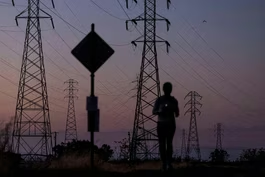
GEOFF BENNETT: In the day's other headlines: More than 70,000 people in Northwest Indiana are without power more than a week after a series of storms down trees, knocked out power lines, and flooded neighborhoods.
Across the state, seven people have died.
Local officials are scrambling to restore electricity as frustrated residents accuse them of not doing enough.
Stephanie Sy has this report.
STEPHANIE SY: As power crews struggle to get the lights back on in Northwest Indiana, residents are waiting in the dark.
ADRIANA HARRIS, Gary, Indiana, Resident: We are now on day 10 no power in Gary, Indiana.
STEPHANIE SY: In Gary, some 20,000 customers are still without power and air conditioning.
Residents like Adriana Harris are posting daily updates and their frustrations on social media.
ADRIANA HARRIS: This is mentally challenging for so many people cannot work.
People cannot do -- live their everyday lives how they used to live them.
STEPHANIE SY: Power has been out for the region since August 11, when 100-mile-an-hour winds and storms swept through Indiana near the Illinois border.
Initially, some 300,000 customers lost electricity.
Gary officials say they will provide residents with three hot meals a day, tarps, and charging stations.
EDDIE MELTON, Mayor of Gary, Indiana: To the families and to the citizens of Gary, we are standing with you.
We are praying with you.
We are also providing as much resources and support as possible.
STEPHANIE SY: In the meantime, local power officials say the repairs are complicated because, in some cases, entire transmission pulse will need to be replaced.
MELODY BIRMINGHAM, President, NiSource Utilities: These are lines that ordinarily take us and systems that ordinarily take weeks or months that we are trying to accomplish in days and/or weeks.
STEPHANIE SY: She assured residents in the predominantly Black city that race and socioeconomic status are not playing a role in the pace of recovery, saying affluent areas are also affected.
But, across the region, anger is a common feeling.
Residents in Griffith, Indiana, shared how their lives are being impacted at a town hall earlier this week.
MAN: I'm diabetic and I have my medicine in a refrigerator.
STEPHANIE SY: As fast as officials say they're working, they don't expect power to be fully restored until next Tuesday.
For the "PBS News Hour," I'm Stephanie Sy.
GEOFF BENNETT: Also today, the U.S.
military says the USS Abraham Lincoln is heading home after reports of poor living conditions following a roughly nine-month deployment.
The Lincoln and its crew of about 5,000 sailors have been deployed as part of U.S.
operations against Iran.
Democratic lawmakers have cited reports of basic supply shortages and mental health concerns for those aboard the carrier.
Admiral Brad Cooper, who heads U.S.
Central Command, dismissed those concerns as old news.
CENTCOM says a new carrier, the USS George Washington, has arrived in the Middle East and is now operational.
Meantime, Iranian officials are condemning the latest U.S.
economic threats, saying that sanctions and other measures targeting Iranian citizens constitute, in their words, crimes against humanity.
In a social media post, Iran's foreign minister said today that U.S.
economic terrorism threatens global economy and sovereignty worldwide.
Last night, President Trump threatened Iran with what he called economic warfare and isolation on an unprecedented scale, saying it will be an economic D-Day.
Then, today, U.S.
Treasury Secretary Bessent said the U.S.
and its allies will -- quote -- "collapse the regime."
Turning now to Europe, severe storms and at least one tornado tore through parts of Germany overnight.
Emergency crews worked to clear dozens of toppled trees and other debris.
Police say one woman was struck and killed.
That's all unfolding as extreme heat and drought are still gripping other parts of the continent.
Wildfires are raging in the Balkans, forming rings of flames like these in North Macedonia.
Firefighters have joined local farmers armed with shovels, but officials say their efforts aren't enough to control the flames.
STOJANCE ANGELOV, North Macedonia Management Center (through translator): The terrain is extremely difficult to work in, with very tall, tinder-like grass.
A police helicopter operated here during the day.
The effect was good, but the fire still broke through again.
GEOFF BENNETT: Today, Russia deployed a firefighting aircraft to Serbia, where authorities have cited a lack of available planes from the E.U.
Meantime, Serbia's shrinking rivers are revealing more sunken treasures.
This steamboat dating from the early 1900s was left completely exposed as the Sava River has receded amid ongoing heat and drought.
Serbian media have dubbed the vessel Sava's Titanic.
A court in China sentenced the founder of property developer Evergrande to life in prison today roughly five years after the company's collapse sent shockwaves through China's economy.
Hui Ka Yan had pleaded guilty in April to charges of large-scale fraud and misuse of funds.
His sentence caps a downfall for the former billionaire who was once Asia's richest man.
The court also find Evergrande companies the equivalent of more $2.3 billion.
Evergrande was once China's premier property developer, and its collapse left so-called ghost cities of unfinished developments in its wake.
Back in this country, federal agents have reportedly seized electronic devices from former Congressman Eric Swalwell and searched his home as part of a federal inquiry into allegations of sexual misconduct.
That's according to several media outlets citing people familiar with the matter.
They say officials confiscated the devices this past Saturday and searched his Washington, D.C., home a day later.
The Democrat from California has been a vocal critic of President Trump.
He spent more than a decade in Congress before resigning in April after multiple women accused him of sexual misconduct.
He has denied all wrongdoing.
Federal health officials have issued their most severe risk level for a recall of frozen blueberries sold at public supermarkets across multiple states.
The FDA says there is a -- quote -- "reasonable probability that the product will cause serious adverse health consequences or death."
Publix had previously recalled various packages of its private label frozen GreenWise Blueberries and mixed berries across eight states, including Alabama, Florida, and Virginia, among others.
The recall was due to E. coli contamination, which has infected at least 12 people.
No fatalities have been reported.
Prince Harry and Meghan Markle's planned return to the U.K.
is fueling renewed interest in the couple, and, in particular, why they're choosing to head back now after six years of living in the U.S.
The duke and duchess of Sussex are reportedly planning to live in a private non-royal residence outside of London.
Harry has previously cited the government's refusal to cover security costs as one reason for their extended absence.
When asked about that today, new Prime Minister Andy Burnham said the family's security would be a private matter.
Meantime, the people of Britain are expressing mixed feelings about their return.
MAN: I'm not especially happy about it because they trashed the whole country numerous times, betrayed their family, betrayed his king, his father.
WOMAN: I personally like Meghan Markle.
I'm pretty sorry.
I think they have built a lovely life together.
And, sadly, I think that, no matter where they live, they're going to get vilified.
And so they just ought to go wherever makes them happiest.
GEOFF BENNETT: While the couple have not commented publicly on their plans, Prince Harry has said he hopes to reconcile with his family, especially his father, King Charles III, who is being treated for cancer.
Well, on Wall Street today, renewed worries about the bond market sent stocks lower.
The Dow Jones industrial average ended the day with a 700-point loss.
The Nasdaq fell exactly 1 percent.
The S&P 500 posted its fourth loss in five sessions.
Still to come on the "News Hour": we speak with a transgender CIA officer who was fired from her job at the White House; why the polling has appeared to be so inaccurate in some of this year's primary elections; and a growing push to preserve small regional racetracks.
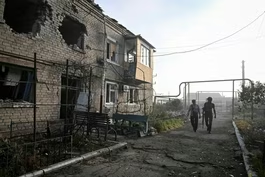
Russian airstrikes across Ukraine overnight killed at least 17 civilians and injured more than 40 others.
Ukraine's air force says Russia launched several missiles and an estimated 168 drones, the latest large-scale aerial assault in a war raging for more than 4.5 years.
Ukrainian President Volodymyr Zelenskyy is calling on the allies to replenish the country's stockpile of Patriot interceptors.
VOLODYMYR ZELENSKYY, Ukrainian President (through translator): We need missiles for Patriots, and only our partners can provide them.
At all levels, we convey to them both what we need and the fact that we know our partners are capable of needing this need.
We aren't talking about gifts.
Ukraine is ready to buy the weapons.
GEOFF BENNETT: For perspective, we turn again to retired U.S.
Army colonel Robert Hamilton, who joins us now from Kyiv.
Thank you for being with us.
COL.
ROBERT HAMILTON (RET.
), Delphi Global Research Center: Thank you for having me.
Good to be here.
GEOFF BENNETT: And you were in Kyiv during this massive Russian strike overnight.
Take us inside that experience.
What happened?
COL.
ROBERT HAMILTON (RET.
): The Russians are able to do this about once or twice a week, where they sort of husband or marshal their ballistic and cruise missiles, because they don't have enough to do this every night in the numbers that they did last night.
So Ukraine through its own intelligence and certainly through intelligence sharing from the United States is almost always able to get early warning.
And this is hours early warning.
When Russia starts to do things that indicate that a large ballistic missile attack may be in the offing, then Ukrainians are able to be warned.
They have -- there's a messaging app that's widely used here called Telegram.
There are multiple Telegram channels that start to broadcast warning.
Early or late afternoon yesterday, we started to get warnings that there were movements under way in Russia that indicated a large attack was likely.
And so people are able to take precautions and get to shelters before the attack happens.
GEOFF BENNETT: And you have been traveling to Ukraine throughout this war.
You have said that people there have grown now accustomed to these attacks, even though they're tired and they're weary, understandably so.
What does that fatigue look like after years of war?
COL.
ROBERT HAMILTON (RET.
): Yes, they're tired, and especially now, over the last month or so, where their Patriot interceptor stocks have dwindled down dangerously low, not zero, probably, because they're probably holding on to some to protect very critical targets, very critical infrastructure.
But what it means is, they're not able to protect against a large-scale attack like happened last night.
And so Ukrainians know this is going to happen.
They have grown accustomed to sleeping in shelters, but you never, I guess, actually get accustomed to that.
But they're still resolved.
The polls indicate that people don't want to give up territory, at least give up territory legally, in other words, cede formally territory to the Russian Federation to stop the war.
Yes, they want the war to end, but they don't want it to come at the permanent cost of their territorial integrity.
GEOFF BENNETT: You're also studying how American weapons and U.S.
military training are performing in this war.
What are you learning?
COL.
ROBERT HAMILTON (RET.
): Well, we're increasingly learning that what we call security assistance or security cooperation in the United States, which is this idea that the U.S.
provides military assistance, so training, equipment, education, advising to its foreign partners, here in Ukraine is much more a two-way street than in many places.
In other words, the U.S.
is learning as much from Ukraine as it's teaching Ukraine, and Ukrainians are sometimes adapting and innovating with U.S.
equipment because of the exigencies of the war.
The war - - the character of war is changing here.
Something that worked six months ago may not work now.
A piece of equipment that could be used in one way a year ago has to be used in a different way now.
So we're here studying that, trying to learn from that and trying to understand it.
GEOFF BENNETT: And this war has become in many ways a laboratory for drone warfare.
There are reports that the U.S.
Army is moving to disband a specialized drone battalion.
Given what you're seeing in Ukraine, how much does that concern you?
COL.
ROBERT HAMILTON (RET.
): What's concerning about that to me is that institutions and organizations matter, right?
So having a dedicated unit -- both Russia and Ukraine have dedicated units for drone warfare.
They have units that their only purpose in being is to understand adapt, and innovate in the drone war.
And that's why you have seen such rapid adaptation and innovation on both sides in the drone war here.
What would concern me about the Army's decision is, when you take away the unit, the organization, the institution whose sole mission it is to understand and integrate these lessons, it's possible that they won't be understood and integrated at the level they should be.
GEOFF BENNETT: After spending so much time in Ukraine and with Ukrainians who are fighting this war, what do you think Americans misunderstand most about where this war stands right now?
COL.
ROBERT HAMILTON (RET.
): Well, I think the narrative is slow to shift.
The narrative all through 2025, at least in the West, was inexorable territorial gains that would result in inevitable Russian victory, right?
And if you're not following the war on a day-to-day basis, you're going to miss the fact that that's no longer what's happening on the ground here.
So the Ukrainians have stabilized the situation at the tactical level.
Throughout this year, 2026, Russia has in many months lost more territory than it's gained.
And so the front lines are stabilized.
Territory is not changing hands at a rapid rate.
It never really was.
Russia's gains were at the tactical level, not operationally or strategically significant.
And then, at the strategic level, I think what we're seeing, and last night was an example of it, is a modern form of a strategic bombing campaign, where both sides now have the ability to reach deep into the other side's territory and hit targets of strategic significance.
So Ukraine is striking Russian energy infrastructure, the Russian military industry, Russian strategic logistics, Russia striking the Ukrainian energy grid, Ukrainian logistics and also, frankly, civilian targets.
And Russian strikes on civilian targets are not an accident.
These aren't these aren't mistakes.
There's so many of them.
They happen so often, to include last night, that it's hard not to conclude that the commission of war crimes is part of Russia's military strategy here.
GEOFF BENNETT: Retired Army Colonel Robert Hamilton, thanks again for your time this evening.
COL.
ROBERT HAMILTON (RET.
): Thank you.
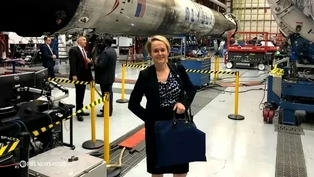
AMNA NAWAZ: Nearly 20 years of service in the intelligence community as a CIA officer ended for Julia Curlee.
Curlee was the first CIA officer to transition openly and continue serving the agency, until she was fired abruptly early in President Trump's second term.
She writes about being targeted as a transgender woman in an essay for "The Atlantic" titled "The Wrong Kind of American," writing -- quote -- "When the economy collapses or a war goes badly, they find a tiny group of people, make them the enemy within, and rally the country against them."
Julia Curlee joins us now.
Welcome.
Thanks for being here.
JULIA CURLEE, Former CIA Analyst: Thank you so much.
Pleasure.
AMNA NAWAZ: You were fired more than a year ago.
You have said in part that you're speaking out now because of a palpable fear among some in the intelligence community, concerns over national security damage.
What do you mean?
JULIA CURLEE: Well, there's been serious damage to two key institutions that really keep us safe.
And so, on one hand, the people and the processes that the intelligence community runs on, the experts with decades of experience are being driven out.
And they're being targeted either for who they are, like in my case, or for what they say if it doesn't agree with what the president wants to hear.
And then the second thing is that the institutions themselves, made up of those people, like the National Security Council, which was effectively neutered last year, so that basic coordination among departments and agencies like the Department of State and Defense and CIA effectively broke down after the White House fired a substantial number of the National Security Council staff at the very beginning of the administration.
AMNA NAWAZ: We did reach out to the White House for comment on your essay, on the interviews you have given since.
Here is just part of what spokesperson Anna Kelly responded with.
She said -- quote -- "President Trump is the duly elected president of the United States.
He can remove any executive branch official at his discretion.
Anyone who writes a 3,000-word op-ed bragging about themselves while attacking the president clearly doesn't belong in public service."
What is your response to that?
JULIA CURLEE: The president absolutely has the authority to remove an executive branch official, especially one working at the White House, but they seem to be confusing the idea of personal loyalty or support for the president's political agenda with what an intelligence officer is supposed to be doing.
An intelligence officer is supposed to speak truth, provide factual information regardless of what the president would prefer to hear.
And I'm sorry that they're shooting the messenger in this case.
But that has been a real problem with the administration from the beginning, where, whenever there's been a prominent case of a piece of intelligence that stands in the way of a policy objective, they have gone after the individual, which is a kind of retaliation that we have not seen at all.
AMNA NAWAZ: Well, I'm going to lean into your expertise as an intelligence officer here and in terms of what we're seeing now, the concerns you're raising about how the intelligence is being used or not used.
What do you make of how the president's handling the war in Iran?
I mean, do you believe he's using the intelligence available to him to make decisions about this?
JULIA CURLEE: No, it's been a debacle from the beginning.
I mean, so you could go back to the firing of the director of the Defense Intelligence Agency when his agency disagreed with what the president would prefer to hear about the status of the Iranian nuclear program.
You could look at the run-up to the war, where there was clearly a failure to plan for several very foreseeable outcomes, such as the closing of the Strait of Hormuz, the decapitation of the regime resulting in the next supreme leader in line.
That had also been predicted, and the U.S.'
inability to open the strait because of a lack of minesweepers.
All of it is planning that could have been addressed in any interagency process.
And I think most palpable for me is, we went into a war of choice that we started, but at the same time you saw half-a-million Americans stranded in the region.
We saw the dependents of State Department officers and families stuck with no way of getting out.
All of these things would have been addressed in a normal NSC-led process that would have brought together Defense, State, and all the instruments of national power.
So, even if you made a bad decision, which I think this attack on Iran certainly was, you would at least have been able to address the worst outcomes, the worst consequences.
AMNA NAWAZ: Julia, you said in a recent interview that the intelligence community has assumed for many years that the president isn't reading the PDB, the Presidential Daily Briefing.
That's the highest-level top-secret information presented with every morning.
Why that assumption?
JULIA CURLEE: Well, I'm not in the room, obviously, with the president, but it was widely believed going into early in his first term that he just simply wasn't reading the product.
We weren't getting the normal feedback we would usually get.
And it is a real problem if this multibillion-dollar apparatus that we have built that is so expensive -- and people take such great risks to give the United States real secrets that give us decision advantage in the world if the ultimate customer doesn't bother to read the product.
AMNA NAWAZ: Let me just back it up a little bit here, Julia, in terms of what got you into this work in the first place.
You cited the influence of your grandfather, who was himself part of an immigrant community, and you have talked about this sense of duty of wanting to serve this country that's given you and your family so much.
Well, how did that lead you into intelligence?
JULIA CURLEE: Well, at the root of what my grandfather was saying was that, in this country, unlike where our family had come from, a person can rise as far as their talents can take them, regardless of who they are.
And, in my life, I got to live a pretty remarkable situation where, despite being trans, despite being a part of a group that's widely misunderstood, I got to rise and work in the White House twice.
AMNA NAWAZ: You rose to some of the highest levels there too.
You were able to brief the president, to brief the vice president, Mike Pence at the time.
But that was in the first term.
Coming into the second term, we saw a lot of anti-trans messaging from the campaign, the Trump campaign going into that.
You stayed on.
AMNA NAWAZ: Did you notice any change in how you were being treated in that second term?
JULIA CURLEE: So what's strange is that I did not in the administration.
I had thought coming into the second term, I had been Mike Pence's PDB briefer.
I had briefed the president on Air Force One in the first term.
I really believed it was my duty to help with the peaceful transfer of power.
And within those first few weeks, despite the chaos mostly induced by the early firings, I never was treated differently.
I made every move I could to deny anyone the pretext of getting rid of me.
I used the bathroom across the street from the White House.
But interacting, no, I was treated very well.
And so, to me, what it underscored was, as long as it was secret, as long as it was in private, as long as they needed me, which they did after they asked me to extend, it was fine that I was trans.
AMNA NAWAZ: If someone inside took that step, what does that say to you about the people around the president and who he's listening to?
JULIA CURLEE: I don't know.
It's clear to me that they're not prioritizing the national security interests of the United States.
There are so many decisions, such as my removal, that I really think can only be explained by a desire to play to a very small extremist part of the president's base, signaling to people on the Internet.
And there have been so many cases of senior officials, senior analysts who have been removed, despite being true experts in their field, because they don't give the president what he wants to hear, because the president's base is demanding vindication for some of the more outlandish conspiracy theories that have been festering on the Internet.
There's been this desire to generate a body count, a desire to purge visibly key parts of the national security system as a way of signaling to the president or to the president's supporters that they're finally rooting out this truly imaginary enemy within.
AMNA NAWAZ: Since you have been speaking out, have you heard from any of your former colleagues inside the White House or at the CIA?
JULIA CURLEE: Frankly, I have been overwhelmed with the number of people that have reached out who are glad that there's someone who can voice what -- if you stood in the Starbucks line at Langley at CIA, you would hear everything that I have said tonight.
You would overhear it by the person next to you.
This is something that everyone knows, but no one feels like they can speak.
And this is going to have generational damage to our intelligence community.
Even if we're fortunate to rebuild in a few years, you're going to have people who have left the profession entirely.
And you just can't grow a 20-year CIA analyst overnight or a chief of station who served in multiple hard-target countries.
And these are the people that are leaving in the hundreds of the intelligence community because they fear that, if they say the wrong thing, if they get on to someone on the Internet's radar, that they will be thrown out for the crime of just following the values of speaking truth to power that we teach all of our young officers.
AMNA NAWAZ: Julia Curlee, we thank you so much for being here today, for sharing your story with us.
JULIA CURLEE: Thank you.
GEOFF BENNETT: We begin a series of stories on Afghanistan tonight that will look at the state of that nation after the American war there ended and 25 years after September 11.
This evening, we have an intimate look at the lives of three people and their families and how they are faring five years after the Taliban wrenched control of the country from the U.S.-supported government.
Special correspondent Leila Molana-Allen and videographer Eric O'Connor, who was in Kabul when it fell, recently returned from Afghanistan and filed this report.
And to note, we have changed the names of all the interviewees in this story for their protection.
LEILA MOLANA-ALLEN: Proud, confident, commanding.
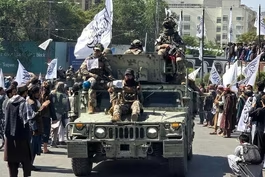
As the Taliban celebrated five years of rule over Afghanistan, its fighters, mounted on flag-decked military vehicles, paraded through in Kabul a show of force.
August of 2021 saw a more ragged battle parade, as Taliban fighters, fresh from taking the country at lightning speed, rode in triumph to the capital.
Just a few weeks before, Afghan National Army soldier Rasool had been fighting these militants hand to hand, stationed in Helmand on the so-called red line, which saw ceaseless fighting and was constantly under Taliban ambush.
He remembers his team rushing to the scene of one too late.
"RASOOL," Afghan National Army Veteran (through translator): When we arrived, one of our friends had been shot several times in his hands and legs.
We took him to the clinic ourselves, but, there, right in front of our eyes, he died.
I was deeply heartbroken.
LEILA MOLANA-ALLEN: So when they were suddenly told to lay down their weapons and return home, he couldn't believe his ears.
"RASOOL" (through translator): We never thought they'd come, change the regime and defeat us.
We never even considered not fighting and surrendering to them.
LEILA MOLANA-ALLEN: Since his return home, Rasool has lived a half-life in the shadows, avoiding the authorities.
ANA soldiers were promised amnesty, but every few days he hears of an old army friend who's been mysteriously killed or disappeared.
In those dark moments, he can't help but ask, what was it all for?
"RASOOL" (through translator): They fought for 20 years, and many people lost their lives.
If they wanted to surrender and hand over the government, they should have done that from the start to avoid all this.
LEILA MOLANA-ALLEN: As Rasool and his comrades surrendered their weapons, panic packed the streets of Kabul.
Tens of thousands of Afghans surrounded the airport, trying to flee in the face of a victorious Taliban, families faint and desperate in the baking August heat, shielding small children at their backs, thrusting foreign passports, visa paperwork, and pleading cardboard signs into the air, willing to try anything to make it through gate after heavily guarded gate to safety to a way out.
Zahra had worked for the U.S.
government for years.
Within hours, Taliban fighters arrived at her home.
Her family hid with a neighbor, awaiting evacuation instructions from her employer.
Next morning, she was called to the airport.
But when she arrived, she was told her small children couldn't come in.
She was there to assist U.S.
officials, not to be evacuated.
Forced to send her 5- and 9-year-olds back, she snuck in with her still breast-feeding baby just 3 months old under her headscarf.
"ZAHRA," Former U.S.
Government Employee: I said: "I have to work.
This is the only way I can save you all.
Otherwise, they will not accept to take us."
And both my kids were hanging on my legs.
They were not allowing me to leave.
And that's -- still to this day, I feel that numbness in my legs.
LEILA MOLANA-ALLEN: Zahra worked 12-hour shifts for five days with little water, shade, food, or rest.
Eventually, her baby fell sick with a fever and severe dehydration.
Officials told her there were no medics available to treat him.
She'd have to board an evacuation flight immediately.
"Not without my children," she replied.
"ZAHRA": I saw there was a huge line.
But my babies are not there.
I refused to sit on the plane.
And I got screamed, I got yelled by the soldiers, by the military.
And I tried to run.
He came after me.
He pushed me.
I was on the ground with my baby.
And then he kicked me.
That was the moment I thought, like, they're lying, and my kids are not here.
LEILA MOLANA-ALLEN: Five years later, Zahra's little girl and boy are still trapped in Afghanistan.
Mina, now 14, is a teenage girl growing up without her mother under a government that bans women from almost everything she imagined her life would be.
That's where your mom is.
"MINA," Daughter of Zahra (through translator): I'm afraid of the Taliban.
When I see them taking Afghan women, I'm afraid that they will take us too.
I feel scared at night when I sleep.
And I'm very stressed during the day.
I feel so sad and depressed.
LEILA MOLANA-ALLEN: She's developed a severe anxiety disorder, struggles to eat, and has constant nightmares.
"MINA" (through translator): I need I need to go to my mother.
I miss her, and whenever I think about her, I start crying.
LEILA MOLANA-ALLEN: Yes, exactly.
I live in the USA.
Mina still dreams of the life in the U.S.
that was promised to her.
"MINA" (through translator): I want to go there and build my life.
Here, schools are banned, and I can't go anywhere.
LEILA MOLANA-ALLEN: Her sick elderly grandmother does what she can, but is struggling.
She barely takes the kids outside now.
Meanwhile, in California, Zahra has been fighting on every front.
Shortly after they arrived, her baby son developed brain cancer.
For seven months, she sat with him in hospital through surgery after surgery, all alone.
"NASRIN," Mother of Zahra (through translator): I worry so much.
She's alone.
My only wish is to see her and hug her.
If I did not see her for just one night, I would miss her.
But now it's been five years.
LEILA MOLANA-ALLEN: Six times, the family has been told their paperwork was processed and they could board a plane to the U.S.
Six times, Zahra waited as they were turned back.
"ZAHRA": The only thing I know is, I'm waiting for my kids.
And that hope is keep me alive.
I tried to end my life two times, actually, but realized that they don't have anyone else except me.
They need me.
LEILA MOLANA-ALLEN: Regret, she says, is the only thing more painful than her broken dreams.
"ZAHRA": I worked for this government.
I put my life in risk, my family's life in risk.
I listened to them.
I trusted them.
I wish I did not.
LEILA MOLANA-ALLEN: Five years later, the Taliban has a firm grip on the capital and most of the country.
But new security threats have emerged.
The regional branch of ISIS continues to launch terror attacks across Afghanistan.
Afghan resistance groups have also hit government-linked targets.
And now members of the disbanded Afghan National Army have announced a fresh offensive against the Taliban.
Those who were once the city's attackers are now its defenders.
Kabul hasn't been so safe in years.
But the increased Taliban patrols and checkpoints have made life for those in hiding from their new leaders riskier than ever.
"MOHAMMED," Former USAID Worker (through translator): These photos are from the night the Taliban released my son.
LEILA MOLANA-ALLEN: Mohammed knows what the Taliban is capable of.
His family has endured their retribution for working with the U.S.
before.
USA?
"MOHAMMED": USAID, yes.
LEILA MOLANA-ALLEN: In 2015, Mohammed was working for USAID, promoting women's rights in rural areas.
Local Taliban fighters saw it as a direct challenge to their values.
His 13-year-old son was kidnapped outside their home and tortured for a month.
They left the family in no doubt why they'd done it.
"MOHAMMED" (through translator): They had tortured him severely.
It looked as if his entire body had been beaten.
They told him, "Because your father works with the Americans, we will kill you."
They would send us videos showing them beating him while he was screaming in pain.
LEILA MOLANA-ALLEN: Eventually, after Mohammed sold everything the family owned to raise a $50,000 ransom, his son was dumped on the street.
He wouldn't regain his sight or hearing for months.
"MOHAMMED" (through translator): At night he would cry and scream, and he thought he was still with them.
Even now, 10 years later, we sometimes see him crying in his sleep at night.
He still hasn't fully recovered.
LEILA MOLANA-ALLEN: Two men were imprisoned for kidnapping and torturing his son.
But when the Taliban took power, they were released.
One of them is now a policeman manning a checkpoint in Mohammed's hometown.
"MOHAMMED" (through translator): One time, I received a call from an unknown number.
He asked: "Where are you?"
I asked: "Who are you?"
He said: "You will recognize me."
We have been living with this stress and fear every day.
LEILA MOLANA-ALLEN: At the end of 2024, the family was told their visas had been approved.
But then came President Trump's executive order freezing the refugee program.
Since then, they have been living in hiding, moving every few months.
"MOHAMMED" (through translator): The only feeling I have now is hopelessness.
Sometimes, I ask myself, why did we work with the Americans for so many years?
Why did we stand beside them?
LEILA MOLANA-ALLEN: Abandoned by those who promised safety in return for service, those who gave their lives to the old Afghanistan have little left to live for here, a historic peace deal, claims of a safer country for all, unless you're being hunted by the very people in power.
For the "PBS News Hour," I'm Leila Molana-Allen in Kabul, Afghanistan.
AMNA NAWAZ: The historic primary season, which has ousted 13 incumbents in Congress, is winding down.
And among the debates it's raised is one over polling.
Results in some high-profile races differed greatly from public opinion polls.
And, earlier this week, one supposed public polling organization announced its results had all been faked as part of a social experiment.
Our Lisa Desjardins has more.
LISA DESJARDINS: Some recent results at odds with polling include the Michigan Senate Democratic primary, where progressive Abdul El-Sayed had double-digit leads in polling, but won over moderate Haley Stevens by just one point, and the Wisconsin Democratic race for governor.
Democratic Socialist Francesca Hong was out front in polling, but ultimately lost the race to David Crowley.
To look at what this means and what it doesn't, as well as how to best use polls, I'm joined by Courtney Kennedy, senior vice president of U.S.
affairs at Ipsos.
So many questions, Courtney, but, first, can you help overwhelmed voters understand, what are primary polls good at and not good at?
COURTNEY KENNEDY, Senior Vice President of U.S.
Affairs, Ipsos: Oh, gosh.
Primary polling is incredibly, notoriously difficult.
I mean, at best, they can give you a sense of how the voters are thinking about the candidates and perhaps which issues are really driving people's motivations and their candidate preferences.
But, again, primary polls are notoriously challenging.
And we see that the amount of error in primary polls is actually like three times higher... LISA DESJARDINS: Really?
COURTNEY KENNEDY: ... than the error you see in national, rigorous polls that we tend to see in the news day to day.
So they're really of a different kind, both in who's sponsoring them and how they're conducted.
LISA DESJARDINS: I know part of the issue is that often primary polls are done by state organizations.
Journalistic organizations have less money to spend on it.
I do want to talk to some of these specific cases.
Let's start with Michigan.
You believe the polls there in that Senate primary overemphasized one kind of Democrat.
How did that happen?
COURTNEY KENNEDY: Yes.
Well, to your point, the organizations who are funding these polls really can only afford relatively inexpensive methods.
And, in Michigan, we saw a dominant way to do polling was what's known as text-to-Web, which is where the pollster sends out text messages with a link to go take a Web survey.
It's cheap because there's no human labor involved, but you get what to pay for.
That methodology, and we saw it in the results, was clearly more effective reaching engaged, more progressive, younger voters, and really struggled to reach moderates in the state of Michigan.
And Michigan was really instructive because there actually was one higher-quality poll that used more rigorous phone interviewing, and it did significantly better, reaching Stevens supporters, reaching more moderates, and representing more moderate support.
So how the polls were done in Michigan really told the tale, and in that state they paid the price for using those less expensive methods.
LISA DESJARDINS: We are separating these cases because they are different.
In Wisconsin, we had a very strange animal, in that right before the primary election, we had three candidates drop out, then one come back in to ultimately win that race.
My question for you about that is, how did polling handle all that?
And was that the issue here, or no?
COURTNEY KENNEDY: That was an incredibly tumultuous race, as you pointed out.
What jumped out to me about Wisconsin was the level of undecided voters.
Just weeks out from Election Day, you had polls picking up 30, 40 percent undecided.
I mean, on one hand, you have to wonder, like, did people in Wisconsin even know that they had an election coming up?
But, on the other hand, it was an incredibly chaotic race, and so perhaps it's understandable that they were unsure what to do.
But that level of undecided voters was really striking and unusual.
LISA DESJARDINS: Wisconsin is also one of those states where a fake organization calling itself Median Strategies put out false polling data, later posting this statement here saying it was a social experiment on how polling spreads.
Neither we nor any national news organizations use their data, but this has raised a point.
How should people figure out if a poll is legitimate, worth their time?
COURTNEY KENNEDY: Well, polls need to be vetted, just like any other source, to your point.
So if you're curious if a poll is real, have you heard of the pollster?
Do they have a track record?
That's a big tell.
And if you go investigate the polling organization, is there a named person with credentials who is putting the their face on that poll?
And details are another big tell.
The more rigorous polls tend to be more transparent about how they're done.
They provide details about the sampling and the weighting and exactly how the questions are asked.
So the more detail, the more documentation, the better.
And if you don't see any people or credible organizations associated with the poll, that's a serious red flag.
LISA DESJARDINS: People don't realize every poll is different, especially now with technology, many different challenges, an exciting time, but a challenging time for pollsters.
Courtney Kennedy, thank you so much for joining us.
COURTNEY KENNEDY: My pleasure.
GEOFF BENNETT: Part of Washington, D.C., is being transformed into a racetrack for this weekend's IndyCar race around the National Mall.
The event has sparked plenty of controversy, but, across the country, smaller local racetracks are at the center of a very different debate, one that's prompting some state legislatures to protect what supporters call the right to race.
Digital reporter Tim McPhillips traveled to a track in Virginia to learn more.
TIM MCPHILLIPS: It's race day at Shenandoah Speedway, like it is most Saturdays in the summer.
STEPFON HAWKINS Jr., Race Fan: I'm thinking about getting back down myself, honestly.
I love it.
WAYNE TOWNSEND, Race Fan: It's a great way to bring people together, people who enjoy racing, who enjoy cars.
CHRIS LILLY, Promoter, Shenandoah Speedway, I will say it's definitely going to be one of the most scenic tracks I think you will go to.
TIM MCPHILLIPS: Shenandoah Speedway, opened in 2005, sits in the heart of the Blue Ridge Mountains, tucked behind a cornfield like something out of "Field of Dreams."
Chris Lilly grew up racing here and now manages the track.
That means he does it all, from pre-race logistics coordinator.
CHRIS LILLY: I answer every e-mail, every phone call, every text.
TIM MCPHILLIPS: To event day race director to crash responder.
CHRIS LILLY: I live 35 minutes away, but this is my home.
TIM MCPHILLIPS: But Shenandoah Speedway and local tracks around the country are under threat.
The Specialty Equipment Market Association, or SEMA, a nonprofit that represents the automobile aftermarket and racing industry, says that, in the past 25 years, the number of motorsports facilities like this one have decreased by nearly a quarter from just about 2,000 to now 1,500.
JOSHUA VADEBONCOEUR, Gardner-Webb University: That loss can be especially significant in a lot of these smaller towns or rural areas that have already lost other institutions.
And the racetrack may be one of the pieces of social infrastructure that still gives people a reason to gather.
TIM MCPHILLIPS: Joshua Vadeboncoeur studies the racing industry at Gardner-Webb University.
One major issue putting the brakes on racetracks, he says the rise of noise complaints and nuisance lawsuits.
JOSHUA VADEBONCOEUR: The track didn't necessarily move close to the neighborhood.
The neighborhood gradually moved closer to the track.
TIM MCPHILLIPS: And even frivolous lawsuits can leave speedways with heavy legal fees.
JOSHUA VADEBONCOEUR: For a local racetrack that's already operating on a very narrow margin in the first place, the process itself can become the punishment.
TIM MCPHILLIPS: These issues have prompted some state legislatures to take up so-called right-to-race laws, which protect existing tracks from noise or nuisance complaints from nearby property owners.
So far, four states have passed right-to-race laws Iowa, Kansas, North Carolina, and South Carolina.
Similar bills have advanced or been introduced in 12 other states.
But with no right-to-race law on the books in Virginia, Lilly sees one thing, future risk.
CHRIS LILLY: If the farm next to us sells and they build 300 houses there, then that immediately puts us in a critical position.
TIM MCPHILLIPS: The speedway, like other community tracks around the nation, is an economic driver for this historic railroad town, Lilly says.
CHRIS LILLY: This district we're in is probably one of the lower income districts in all of Page County.
And this track means a lot to the town of Shenandoah, to the local businesses.
TIM MCPHILLIPS: And for drivers, racing is more than a hobby.
Kenny Snow races alongside his son, Kenan (ph), and his friend, Travis.
KENNY SNOW, Driver: This is a backbone of motorsports.
I mean, you can watch big dogs on TV, but this is where it all starts right here.
TIM MCPHILLIPS: That is especially important for younger drivers.
JACK OWENS, Driver: I am 14 years old, and I started racing about 10 years ago.
Racing in itself is like its own community, different from everything else.
JILLIAN CROWDER, Driver: Me and my family used to always go to the track and stuff and just kind of looking at them, and you kind of get the itch.
ZACH SPROUSE, Driver: My dream is one day to work in NASCAR somehow, whether that's as a driver maybe or as a crew chief.
TIM MCPHILLIPS: But when one track closes, the social community built there can't just transfer to another one, which might be hours away.
JOSHUA VADEBONCOEUR: For the town, obviously, there might be certainly a big time economic loss if the track goes away.
The harder loss to measure is social and cultural.
TIM MCPHILLIPS: John Allen is the general manager of two longstanding speedways in Kansas.
He recalls when tracks were forced to close prior to the state's right-to-race law.
JOHN ALLEN, General Manager, 81 Speedway and Humboldt Speedway: They got shut down because somebody had more money than they did.
TIM MCPHILLIPS: Now protected from nuisance claims: JOHN ALLEN: Gives me optimism that we will be able to operate for a long time.
TIM MCPHILLIPS: But noise and nuisance complaints aren't the only pressure point for both local racetracks and the racing community.
Rising land values can make it hard for racetracks to expand or simply become too valuable to hold on to.
JOSHUA VADEBONCOEUR: But, economically speaking, the property may be worth far more to a developer than it has as a weekly operation for racing purposes.
TIM MCPHILLIPS: Back in Virginia, Lilly says his community at Shenandoah Speedway brings tourists and locals to where the mountain roars.
He doesn't want that to change.
CHRIS LILLY: Long term, I just want this place to be the -- to its full potential.
TIM MCPHILLIPS: For the "PBS News Hour," I'm Tim McPhillips in Shenandoah, Virginia.
AMNA NAWAZ: And that is the "News Hour" for tonight.
I'm Amna Nawaz.
GEOFF BENNETT: And I'm Geoff Bennett.
For all of us here at the "News Hour," thanks for spending part of your evening with us.
 New
NewAfghans who worked with U.S. reflect on life under Taliban
Video has Closed Captions
5 years after the U.S. left, Afghan allies reflect on life under Taliban rule (9m 47s)
 New
NewCan 'right to race' laws protect American tracks?
Video has Closed Captions
'Right to race' laws aim to protect racetracks from noise complaints (4m 57s)
 New
NewIndiana residents frustrated amid 10-day power outage
Video has Closed Captions
Indiana residents frustrated amid 10-day power outage following storms (2m 24s)
 New
NewNews Wrap: U.S. carrier heading home after long deployment
Video has Closed Captions
News Wrap: USS Abraham Lincoln heading home after 9-month deployment (6m 13s)
 New
NewOusted CIA officer warns politics undermining intelligence
Video has Closed Captions
Ousted transgender CIA officer warns White House politics undermining U.S. intelligence (9m 32s)
 New
NewWar crimes part of Russia's strategy, ex-U.S. colonel says
Video has Closed Captions
War crimes are part of Russia's strategy in Ukraine, retired U.S. Army colonel says (6m 28s)
 New
NewWhy primary polls appear to be so inaccurate this year
Video has Closed Captions
Why primary polls appear to be so inaccurate this year (5m 30s)
 New
NewWhy Treasury yields are at 20-year highs
Video has Closed Captions
Why Treasury yields are at 20-year highs – and why it matters (7m 13s)
Providing Support for PBS.org
Learn Moreabout PBS online sponsorship
- News and Public Affairs

Today's top journalists discuss Washington's current political events and public affairs.

- News and Public Affairs

FRONTLINE is investigative journalism that questions, explains and changes our world.



 New Episode


 New Episode
 New Episode
 New Episode
 New Episode
Support for PBS provided by:
Major corporate funding for the PBS News Hour is provided by BDO, BNSF, Consumer Cellular, American Cruise Lines, and Raymond James. Funding for the PBS NewsHour Weekend is provided by...