
Here and Now
Howard Schweber on First Amendment rights and Encampments
Clip: Season 2500 Episode 2506 | 10m 37sVideo has Closed Captions
Howard Schweber on protest encampments in Madison and freedom of speech and assembly.
UW-Madison political science professor emeritus Howard Schweber considers protest encampments in Madison and responses by authorities given the breadth of and limits to freedom of speech and assembly.
Problems playing video? | Closed Captioning Feedback
Problems playing video? | Closed Captioning Feedback
Here and Now is a local public television program presented by PBS Wisconsin
Here and Now
Howard Schweber on First Amendment rights and Encampments
Clip: Season 2500 Episode 2506 | 10m 37sVideo has Closed Captions
UW-Madison political science professor emeritus Howard Schweber considers protest encampments in Madison and responses by authorities given the breadth of and limits to freedom of speech and assembly.
Problems playing video? | Closed Captioning Feedback
Where to Watch Here and Now
Here and Now is available to stream on pbs.org and the PBS app.
Providing Support for PBS.org
Learn Moreabout PBS online sponsorship>> The First Amendment to the Constitution protects our freedom of speech and the freedom to assembly, including to protest.
But what are the limits to those rights?
For that, we welcome UW Madison political science professor emeritus Howard Schweber.
Thanks for your time today.
>> Well, thank you for having me.
>> So when protestors initially took over the intersection where a man was shot and killed by police, they were exercising their right to assemble.
Were they still within their legal constitutional rights to be in that public space?
>> No, or to put it differently, not necessarily.
So let's back up a step.
The way these kind of rules, the way rights in general, we talk about them is not in terms of you have the right to do x, but in terms, can the government stop you from doing x?
It's always a negative constraint on what the government may do, with the implication that anything that's not prohibited, you must be left free to undertake.
So the rules are, the government is perfectly free to make what are called content-neutral time, place, and manner regulations.
And these are things like don't use loudspeakers at night.
Don't camp overnight in a park.
Those are actual old cases.
So there's no question that cities and states have the authority to make those rules so long as they're content-neutral.
You can't say, for example, no blocking the streets in a protest unless it's a protest about schools, or no blocking the streets except for political purposes, or something like that.
So these are very broad, very straightforward rules, a general neutrality principle and a general rule of the regulation should go to the way expression's being undertaken, not its content.
There are two complicating factors.
One is when a city or state makes these rules, they have to be as little restrictive of expression as is possible.
So an easy case of a valid rule, don't block the street.
An easy case of an invalid rule, don't speak so loudly that someone is offended.
Somewhere in between there is the space of difficult cases of does this rule, in the name of preserving order, the name of a time, place and manner regulation, have the effect of unnecessarily limiting people's ability to express themselves?
The other complicating factor is whatever rules are adopted, there has to be adequate alternative avenues for expression.
So this comes up a lot, for example, if you think about the protests years ago with the World Trade Organization in Seattle that got a lot of attention.
And that was one of the first times we saw the use of free speech zones, police saying this area and only this area is where protest is allowed.
And the question was, did that leave adequate alternative avenues?
So those are the broad general principles, and having said all that, setting up an encampment that blocks traffic and close businesses, yeah, that's very clearly something that is not protected by the First Amendment and something the government is perfectly free to put an end to.
>> So what happens, then, when a city doesn't enforce those rules?
>> Right, so this is, and of course, you know, I think we all recognize that the broader context of this goes back to Black Lives Matter and the pro-Palestinian encampments that got so much attention during the 2024 presidential election and the first months of President Trump's term.
We've seen a growth, a considerable growth in the last few years, of protests and of protests in the form of encampment.
It's just become a style of protesting that's become popular.
And one of the problems that raises precise the problem you just mentioned, which is, and you're exactly right to ask that question, what happens if in the application of the rules I'm talking about, the state is inconsistent?
What if some encampment's allowed and others, you know, are taken down?
And that was precisely the claim that was made in the case of the pro-Palestinian encampments and pro-Israel legislators and citizens who objected to the way they were being treated.
The claim was it was inconsistent.
These encampments were being allowed, these students were being allowed, being permitted to be disruptive in a way that other student protestors had not been.
So a city or a state can run into trouble by showing favoritism as well as disfavor.
If you only go after, if you only apply these rules to protests or encampments that are from a single perspective, or you don't apply them to a single privileged perspective, imagine, for example, a city that never enforces these rules against religious protestors, but always does against political protestors, right?
That would violate that content neutrality thing.
So the application of the rules has to be neutral as well as their formulation.
And that's exactly where most of the time you get into trouble because the flip side is whether we're talking about a city or a university or a state government or any police force, discretion is always part of the job description, using your judgment, deciding when to step in, deciding how much leeway to allow.
And that always opens the possibility of someone claiming you're being inconsistent.
So the city of Madison here, to a certain extent, was caught in a bind.
If they failed to act in response to these encampments, they would be subject to accusations that they were showing favoritism to that political cause on the grounds that they would have intervened if these encampments had been created for other purposes.
And that's probably true.
Let's just make up a case.
Imagine a group of people who want to abolish the Establishment Clause of the Constitution so that America can become a forthright Christian nation.
And to express their views, they block an intersection for a period of days.
One suspects they'd be removed in pretty short order.
So the city of Madison can't treat these protestors differently without running the risk of a constitutional violation.
>> So we've talked about the word encampment coming around in protest movements more.
And you know, we can go back 15 years to the Act 10 protests.
>> Sure.
>> Where the Capitol was occupied for more than a month.
There were protest zones within there where the protestors themselves prevented media from accessing certain halls, legislators from getting into their offices.
That was negotiated in terms of how people would exit the Capitol, the preservation of materials.
There were very few arrests down to the last handful of people brought out.
Obviously the Palestinian protest encampment on UW-Madison required police intervention.
This one did, so - >> Well, we should be clear on this.
The Palestinian protest encampment at UW-Madison was tolerated for a considerable period of time.
The university and, you know, this is the bind that they're in.
They tried to do this with a gentle hand.
They tried to exercise discretion to maximize the ability of students to express themselves.
They tried to find a balance between allowing this expressive activity to go forward while preventing disruption.
But that becomes the problem.
So take Act 10, for example.
Many conservatives who opposed the protest, who supported Governor Walker, were deeply upset.
Why are the police not throwing these people out?
Why are they letting these people occupy our Capitol building and prevent the business of the government from going forward?
Would they do the same if this was the Ku Klux Klan?
And again, they're not wrong.
The answer, I hope, is no.
So this just gets back to the point I was making earlier.
There is a history of encampments and takeovers in recent years.
I think the Act 10, I think of that differently.
>> Yes.
>> More of an occupational building, but that's fine.
And governments have been wrestling with them.
And the politics around those government responses has been so amplified and made so partisan and fraught because of the way Trump treated those issues when he ran for president in 2024, that now, you know, all the cities, the universities, states are on tenterhooks, trying to figure out what's the right way to proceed.
And the error on the side of caution is intervening and moving the encampments out rather than being unduly tolerant.
>> So I want to read you a statement from the ACLU of Wisconsin, which they said the police response was excessive and heavy-handed saying, "When armed police show up and begin aggressively arresting and pepper spraying protestors, it can jeopardize the safety of everyone involved, including demonstrators, law enforcement, and the surrounding community."
So where does that statement fall within this argument?
>> So I'm a big fan of the ACLU in general.
That doesn't mean I agree with every statement every representative makes.
This one, I'm not sure about.
Now, at the end of the day, this is about knowing specific facts that I don't know.
And we will not know publicly unless and until there are criminal trials or investigations or some other fact-finding process.
We're all relying on what we hear, either in the media or from participants.
But I have seen reports of a dozen fires.
I've seen reports of more than 10 firearms being seized.
The narrative is that the, and again, I can't vouch for the truth of this narrative, that the encampment had gone beyond being a protest encampment and become a general homeless encampment, and that when the police came to move in, they encountered resistance.
So it is entirely possible, based on my limited knowledge of the facts, that the police acted completely proportionately, proportionately, excuse me, in response to violent aggression.
There's a very disturbing scene of a city employee, the interim police monitor who represents the community, pushing a police officer and later appearing on social media, making what sound like threatening statements, threatening violence.
If those are accurate, I mean, there may be some context, but if that's really happening, if statements like that are being made by city officials, if there's violent resistance to the police carrying out an order to remove these encampments, then I'm afraid the ACLU was wrong.
That is unfortunate, but potentially necessary.
Whether, you know, specific questions of police tactics were decided in an unfortunate way, I have no idea.
And let us leave open the possibility because it's far too late to close that barn door, that the police were over-aggressive and took advantage of the situation to dish out a little discipline of their own.
That's possible.
I do think it's premature, based on what I know, at least, for the ACLU to be making a claim like that.
>> So kind of put a bow on this in terms of the First Amendment and protestors.
>> Right.
>> Because a lot of people say, "Well, it's my First Amendment right."
What is the great confusion there that comes within the bounds of your rights versus someone else's rights?
>> Right.
So the very short version is you have a right to protest up to the point where you're disrupting other people's ability to go about their day.
It's a simplistic version, of course, but it's not far off.
If you block streets, if you block sidewalks, if you block access to businesses, if you block people's ability to get in and out of their home, if you disrupt the operation of classrooms, for example, none of those is protected by the First Amendment.
The First Amendment protects the right to express yourself in ways that are peaceful and discursive.
There simply is no protection for engaging in, well, civil disobedience.
And the reason we call it civil disobedience is that when you do that, when you deliberately march into a racially segregated lunch counter and integrate it, right, you acknowledge you risk being arrested and suffering the punishment.
That's part of the whole civil disobedience paradigm.
And it's an honorable, it can be a very honorable thing, but there is not a First Amendment right to engage in acts that would otherwise be crimes.
>> All right, Professor Schweber, thanks for your time today.
>> Thank you so much.
 New
NewHere & Now opening for August 7, 2026
Video has Closed Captions
Clip: S2500 Ep2506 | 58s | The introduction to the August 7, 2026 episode of Here & Now. (58s)
 New
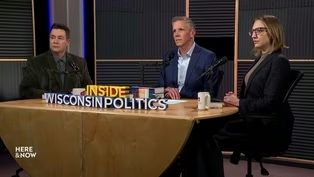
NewInside Wisconsin Politics: The 2026 Primary Election Arrives
Video has Closed Captions
Clip: S2500 Ep2506 | 3m 21s | Inside Wisconsin Politics on how Democratic primary campaigns for governor have played out. (3m 21s)
 New
NewTribal Sovereignty is at Issue in Lac du Flambeau's Lawsuits
Video has Closed Captions
Clip: S2500 Ep2506 | 6m 6s | Asserting sovereignty is key to the Lac du Flambeau Band's moves to limit fishing access. (6m 6s)
 New
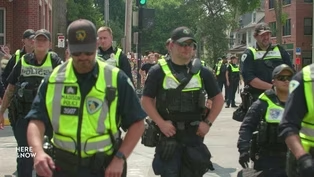
NewWhat's Next for Madison After the Ruiz Shooting Encampment?
Video has Closed Captions
Clip: S2500 Ep2506 | 4m 43s | The city of Madison cleared a protest encampment 13 days after Corey Ruiz was killed. (4m 43s)
 New
NewWisconsin's 2026 Primary for Governor Hits the Home Stretch
Video has Closed Captions
Clip: S2500 Ep2506 | 4m 52s | Four Democratic candidates remain in the 2026 primary for governor of Wisconsin. (4m 52s)
Providing Support for PBS.org
Learn Moreabout PBS online sponsorship New Episode
- News and Public Affairs

Top journalists deliver compelling original analysis of the hour's headlines.
 New Episode
- News and Public Affairs

Today's top journalists discuss Washington's current political events and public affairs.
 New Episode
 New Episode
 New Episode
 New Episode
 New Episode


 New Episode
 New Episode
Support for PBS provided by:
Here and Now is a local public television program presented by PBS Wisconsin