
The Tortoise that Saved the Rabbit | Wild Critters USA
Special | 27m 16sVideo has Closed Captions
Discover the incredible Mojave desert tortoise on this family episode of Wild Critters.
Did you know a single desert tortoise burrow can become a shelter for dozens of animals? In this episode of the Wild Critters USA series on Orbit: Science for Kids, families explore the Mojave Desert with the help of the U.S. Fish and Wildlife Service, and discover why the desert tortoise is one of the most important animals in its ecosystem. Perfect for kids 3-11 years old.
Problems playing video? | Closed Captioning Feedback
Problems playing video? | Closed Captioning Feedback
Major support for NATURE is provided by The Arnhold Family in memory of Henry and Clarisse Arnhold, Sue and Edgar Wachenheim III, The Fairweather Foundation, Charles Rosenblum, Kathy Chiao and...
The Tortoise that Saved the Rabbit | Wild Critters USA
Special | 27m 16sVideo has Closed Captions
Did you know a single desert tortoise burrow can become a shelter for dozens of animals? In this episode of the Wild Critters USA series on Orbit: Science for Kids, families explore the Mojave Desert with the help of the U.S. Fish and Wildlife Service, and discover why the desert tortoise is one of the most important animals in its ecosystem. Perfect for kids 3-11 years old.
Problems playing video? | Closed Captioning Feedback
Where to Watch Nature
Nature is available to stream on pbs.org and the PBS app.
Buy Now
Explore More Ways to Watch
Bring the beauty and wonders of wildlife and natural history into your home with classic NATURE episodes.Providing Support for PBS.org
Learn Moreabout PBS online sponsorshipMore from This Collection
To celebrate America's 250th anniversary, PBS Nature is teaming up with Orbit: Science for Kids on the Move! and National Wildlife Federation's Ranger Rick to bring you stories of creatures from around the United States.
 New
NewThe Race To Save Three Mountain Lion Cubs | Wild Critters USA
Video has Closed Captions
Three orphaned mountain lion cubs and one epic rescue mission. Join us on Wild Critters! (28m 10s)
How Tiny Corals Build Underwater Cities | Wild Critters USA
Video has Closed Captions
Kids discover coral reefs on this Wild Critters episode with the Smithsonian. (31m 13s)
A Monarch Butterfly’s 3,000-Mile Journey | Wild Critters USA
Video has Closed Captions
Follow the monarch butterfly's incredible 3,000-mile migration to Mexico. (29m 9s)
The Turtle that Dances for Worms | Wild Critters USA
Video has Closed Captions
Meet Wanda, the wood turtle who dances to trick worms out of the ground. (25m 47s)
How Do Baby Bald Eagles Learn To Fly? | Wild Critters USA
Video has Closed Captions
Discover how bald eagles build giant nests and learn to fly! (27m 16s)
Ice Age Secrets Frozen in Mammoth Poo | Wild Critters USA
Video has Closed Captions
Discover mummified mammoth poop and the Ice Age secrets it holds. (29m)
Meet Nature's Water Cleaners | Wild Critters USA
Video has Closed Captions
Discover how tiny freshwater mussels keep streams healthy! (27m 29s)
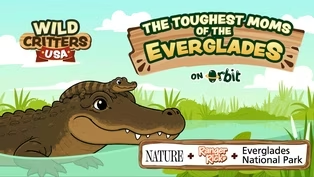
The Toughest Moms of the Florida Everglades | Wild Critters USA
Video has Closed Captions
Discover the amazing American alligator and the wetlands of the Florida Everglades. (27m 28s)
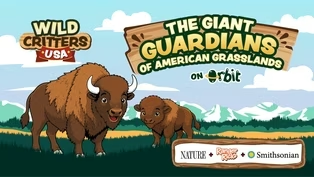
The Fluffy Guardians of American Grasslands | Wild Critters USA
Video has Closed Captions
Families discover America's largest mammal with Orbit, PBS Nature and the Smithsonian. (30m 4s)
Official Trailer | Wild Critters USA
Video has Closed Captions
Explore amazing American wildlife and outdoors in this family podcast series! For kids ages 3-11. (1m 11s)
Providing Support for PBS.org
Learn Moreabout PBS online sponsorshipThis episode is part of the Wild Critters USA collaboration with Orbit, PBS Nature and the National Wildlife Federation.
- Hank, are you ready?
- Woof.
This summer we're hitting the road to visit wildlife neighborhoods all across America to meet some of our wild neighbors.
We'll call it the Wild Critters USA Road Trip.
We'll explore deserts, wetlands, oceans, mountains and more to discover the amazing animals that call the United States home.
We have so many friends to meet.
And today, our first stop is the Mojave Desert in Arizona.
Speaking of deserts, Hank, it is hot.
Like really hot.
I know, buddy.
If I were a desert animal, the first thing I'd is find some shade.
Let's see.
Let's walk over here and squat behind this tiny bush.
Nope.
Still hot.
Maybe if we go stand behind that rock.
Still hot.
What if we hide behind that cactus?
Ouch.
Be careful.
Hank it poked me.
Ooh.
If we're having this much trouble staying cool, Where do all the desert animals go?
That reminds me of this question from our friend Caleb.
Hello, my name is Caleb.
I'm three years old.
How do you to tortoises hide from bad weather?
And out here, bad weather in the Mojave Desert can mean months above 100 degrees Fahrenheit.
I heard about a tortoise out here who digs holes to stay cool, but not just that.
Other animals use the holes too, maybe even snakes and owls.
So we have a lot to explore together and to help us out, we found an incredible guest, Brianna from the US Fish and Wildlife Service.
But first, let's go say hi to Milam.
Hey there, Orbiters.
We are back in action with our buddy Milam.
Milam, welcome to Orbit.
I promise That's Milam.
He hasn't been replaced by some kind of a weird small alien.
Milam, what is, what's going on?
What's new in life?
- I just had my eighth birthday and I got a light up chess board.
- A light up chess board?
I didn't know you were a chess player.
- I wasn't until that.
- Okay.
So now we are, have you enjoyed learning about chess?
- Yeah.
- Yeah?
What do you like about it?
- I just like it.
- Do you have a favorite piece?
The Queen.
It can move anywhere.
- Yeah, the queen?
And diagonally that way or up... - Diagonally, horizontally or vertically.
- Yeah.
It's so good.
You could kill their queen king.
It wouldn't let you them, but you could put it in check mate.
- That's right.
Yeah.
So are you learning to play with your, with your siblings or with your mom and dad or with your friends?
- My dad, my brother, or sometimes even myself.
Yeah, sometimes I play bots, but my favorite thing to do is play myself.
And I always play easy on myself so I can always win.
I've never lost whenever I've done that.
- But if you play against yourself, you probably win.
And you lose though, right?
- Well, I always choose to be one person.
- Oh, oh, okay.
Gotcha.
When you, when you play with your little brother, who's better at chess right now, you or Wells?
- Me.
- Y'all play a lot together?
- Yeah, usually we do it about once or twice a day.
- That's really cool.
You, you know, when I was your age, my brother and I learned to play chess together and Jeffrey was better than me.
He was just really, really good at chess.
So you have to watch out for those little brothers.
You're like, "I'm not, I'm not worried about it, Robert.
I'm pretty sure I've got this handled."
Well, hey, today we are gonna learn about the incredible Mojave Desert Tortoise.
We'll learn about the burrows that a tortoise digs and all the animals that use the burrows.
Hey Milam.
To start this one out, I want you to imagine that you dug a burrow in the desert.
Do you know what a burrow is?
- It's like, kind of like a hole.
That's your, that's an animal's home.
- Yeah.
Yeah.
It's like a hole or like a cave or something.
And we want to go into your imagination.
Can we join you in this little journey, Mr.
Milam?
- Yeah.
- Yeah.
Okay.
Let's crawl into your burrow home.
How do we get into the burrow?
- No one except me knows because it's a pit trap where if you step on something then you fall into my burrow.
- Okay.
So your burrow is also a trap door.
And what does it feel like inside of your burrow, Mr.
Milam?
- Very hot.
Like about as hot as a hot tub and it smells like wombat poop.
- It's okay.
So it's hot.
It smells like wombat poop.
That's oddly specific.
Do you know what wombat poop smells like?
- Horrible.
Yuck.
- Okay.
And are there other little critters that are inside of your burrow?
- Western Diamondback rattlesnakes.
So there's a western Diamondback rattlesnake.
Is there, are there a bunch of them or just one or two of them?
- Maybe a few million.
- A few million.
But you live in a burrow that smells like wombat poop, is really hot, and is full of Diamondback rattlesnakes stuff.
This does not sound like a very fun place to spend time.
Okay.
And when do you come out of your burrow?
- Only whenever I need to use the bathroom.
'cause there's no bathroom.
- Okay.
There's no bathroom.
So you have to go outside for that?
Yeah.
Okay.
How do you get past the Diamondback rattlesnakes?
- You can just easily, just throw some pasta at them 'cause they're pasta lovers.
They chase you until you throw pasta at them.
- Okay, so always have pasta.
If you forget your pasta, you're gonna be in trouble.
But as long as you have pasta, you can.
So families one.
Thank you, Milam, for bringing us into your very active imagination.
Families, you can pause here and do this activity together.
Orbiters, can describe what would their burrow be like?
Hey Milam, are you ready to learn about the Mohari desert tortoise today?
- Let's do it, man.
- Okay, perfect.
So today's guest is Brianna from the United States Fish and Wildlife Service.
- Hi Brianna, welcome to Orbit.
What do you do for work?
- Hello, orbiters.
My name is Brianna Fogel and I am a fish and wildlife biologist with the US Fish and Wildlife Service.
At the Fish and Wildlife Service, we work to conserve, enhance and protect fish, wildlife, plants and their habitats for the continuing benefit of the American people.
But we also work with others to protect species that live outside of the US that migrate or are illegally trafficked or that are in danger of extinction.
- Hey, what were you like as a kid?
- I was always outside exploring the natural world and I loved to read.
My family and I would take lots of walks down to our neighborhood park to see all of the local wildlife and I was always found reading any animal or science books that I could get my hands on.
- Hey Milam, you ready to get started with the episode?
- Yes.
Let's do it.
- Here we go.
- Hello, my name is Josh and I'm five years old.
My question is, what is a desert?
- I love this question to start us off.
Hey orbiters, let's test your knowledge.
Which one of these does a place need in order to be a desert?
Does it need to be really hot?
Does it need to have very little rain?
Does it need cactuses?
Does it need sand dunes?
Shout out your hypothesis.
Okay, Brianna, what is a desert?
- Hi, Josh.
Great question.
A desert is a very dry place, where it hardly ever rains - less than 10 inches or 25 centimeters of rainfall in a whole year.
Some deserts are super hot like the Sahara Desert in northern Africa, while others are freezing cold like parts of Antarctica.
- Isn't that interesting, Orbiters?
A desert just means a place with very little rain and some super cold places are also deserts like Antarctica.
Today's co-host Milam wanted to learn more.
- Hello, I'm Milam.
I'm seven years old and I live in Houston, Texas.
And my question is, what is the Mojave Desert like?
Bye.
- Hi Milam.
The Mojave Desert in North America stretches across parts of California, Nevada, Utah and Arizona.
It doesn't get much rain, only about two to six inches each year.
In the summer it can get really hot, often going over a hundred degrees Fahrenheit or 38 degrees Celsius, - Very hot and very little water.
I bet nothing lives in the Mojave Desert.
- But even though it can be hot and dry, the Mojave Desert is full of life.
Plants here are amazing because they have evolved clever ways to survive extreme heat and drought.
Some grow very long roots to help reach water deep underground and waxy leaves to help reduce water loss.
The Mojave is also home to a wide variety of tough animals like desert tortoises, Mojave rattlesnakes, quails, mountain lions, and big horn sheep.
These animals survive the desert by evolving ways to conserve water, only coming out at night when it's cooler and using underground burrows where temperatures are much lower than a on the surface.
- I can't wait to learn more about these adaptations, but this brings to mind a very interesting question that our friend Milam sent to us.
- My question is, why don't desert animals leave to go to somewhere cooler?
- I agree Milam, if I lived in the Mojave Desert, I would pack my bags, hop on my trusty tricycle and pedal my way to somewhere cooler.
But that's not what other animals do.
We brought this question to our friend David Mizajewski.
Mr.
David is a science advisor for Ranger Rick Magazine from the National Wildlife Federation and is helping us out with the Wild Critters Series.
Hey Mr.
David, why don't desert animals just find a cooler place to live?
- Great question.
Milam.
Deserts are often hot and dry places, too hot and dry for a lot of kinds of animals to be able to survive there.
But animals that naturally live in deserts like the Mojave have adaptations, which are special body parts or behaviors that allow them to thrive in those hot and dry conditions, so they can easily go without drinking water for a long time or have the ability to burrow underground to get away from the heat.
If species like the desert tortoise moved to a different kind of environment that was wetter or cooler, they actually wouldn't like it because they're meant to live in the desert.
Deserts are actually their perfect habitat.
- That is so interesting.
Mr.
David.
Hey parents, if your curious little ones wanna continue learning about desert ecosystems?
Ranger Rick Magazine from the National Wildlife Federation has lots of great wildlife resources.
I'll leave a link in the show notes.
- Hi Orbit.
My name is Ygrette Mostajo.
I'm 10 years old.
I live in Santa Cruz, Bolivia.
And my question is, why are there many types of tortoise and turtles?
- Excellent questions, Ygrette and Logan.
So all tortoises are a type of turtle.
The main difference is where they live and how their bodies are built.
Tortoises live only on land and have big heavy domed shells and strong, sturdy legs, kind of like elephant feet to walk around and help them dig.
- Orbiters.
Next time you're at a zoo, look closely at a tortoise's legs.
They do look kind of like elephant feet, but a lot smaller and beneath a tortoise instead of beneath an elephant, Turtles are adapted to life spent in water.
Their shells are smoother and flatter, and their feet are webbed and look more like flippers to help them swim through the water.
So the Mojave Desert Tortoise is like a special type of tortoise that is found in the Mojave Desert in the United States.
Hey orbiters.
I asked Brianna how long the Mojave Desert Tortoise can live without a drink of water.
How long do you think they can go?
Is it a week, a month, four months or a year?
If you make it to the end of the episode, you'll learn the answer.
Alright, let's keep learning about these amazing tortoises.
- Hi Orbiters.
My name is Jaden.
I'm nine years old.
I live in Quaretaro, Mexico, and my question is, how big do desert tortoises grow?
- Hi Jaden.
Desert tortoises can weigh eight to 15 pounds.
That's like a bowling ball.
Their length is about nine to 15 inches, about as long as a loaf of bread.
They are slow growing reptiles and can take 13 to 20 years to reach their maximum size a lot like us.
- Hey Brianna.
You mentioned that tortoises have super strong shells.
I don't have a shell.
Hank doesn't have a shell.
I know Hank, it would be very cool if you had a dog shell.
Why does the Mojave desert tortoise get to have a shell and we don't?
- So their shell works like built-in armor that moves with them and helps to protect their soft insides.
The colors and patterns on their shell also help camouflage them so it's harder for predators to spot them.
A shell is made up of two main parts.
The top is called the carapace and the bottom is called the plastron.
They are connected on the sides by something called a bridge.
- Hey, orbiters, what do you think a tart shell is made out of?
Is it a special desert?
Rocks glued together by nature?
B. Bones that come from the tortoise's rib cage, C. Cactus leaves that the tortoise puts together Or D. The same stuff your hair and nails are made of.
Shout out your answer.
- The shell is actually part of the tortoise's body it's made from bones that come from the rib cage and the spine along with some cartilage.
The outside of the carapace is covered in little plates called scutes, which are made of keratin, the same stuff your hair and nails are made of.
- I know Hank, it was a trick question.
So the shell is made from bones and the outside is made from the same substance as your hair and nails.
Did you choose one of those, orbiters?
- Hi, my name is Ariana.
I am six years old.
I live in Miami.
And my question is, what do they eat in the desert?
- Hi, Ariana.
The Mojave Desert Tortoise is an herbivore, which means it only eats plants.
The tortoises get most of the water they need from eating plants like grasses and wild flowers in the spring.
But on warm days when it's cloudy or raining, they come out of their burrows to find water.
Sometimes they even dig their own small holes to catch rainwater.
Pretty clever.
- These sure are crafty little tortoises.
Hey, we're about to learn about tortoise burrows.
But first, how about a mystery sound.
Think you got it.
Stick around to the end for the answer.
Okay, let's get back to more questions.
- Hello, my name is Caleb, and I'm three years old.
How do tortoises hide from bad weather?
- Yeah.
If I lived in a super hot desert, I would want to hide too.
- Hi, Caleb.
Tortoises are very smart and spend more than 95% of their time undercover to avoid harsh desert weather.
They are excellent diggers.
When it gets too hot, they dig their own burrows or hide in rock shelters and special caves called Caliche caves.
- Hi, my name is Luna.
I am six years old and I live in New York.
And my question is, how do Mojave desert turtle tortoises make burrows?
And turtles and tortoises are my favorite animal.
- Hi Luna.
These tortoises use their strong, slightly flattened front legs and long tough claws like digging tools to make different kinds of burrows.
Some burrows are used just for a short time, while others may be used for several years.
They dig shallow underground hideouts to escape the hot desert summer or tunnels up to 30 feet or nine meters long to stay nice and hidden during cold winter days.
Complex deep burrows can take days or weeks to dig.
Wow, isn't that crazy?
Orbiters.
So these tortoises can dig tunnels that are almost as long as a school bus.
- Hey, Brianna.
Milam told us that in his burrow he would've rattlesnakes.
Would a rattlesnake or other animals use a tortoise burrow?
- Great question.
Gila monsters, rattlesnakes, sidewinders, road runners, burrowing owls and kangaroo rats, among lots of other species all use the tortoises burrows for shade, safety and shelter.
- Hey orbiters, this is a great moment to pause and talk as a family or with a friend.
Let's imagine you are a Mojave desert tortoise and you dug the best, the coolest, the shadiest burrow in the entire Mojave Desert.
What types of animals would you like to help protect?
Here are some options that Brianna mentioned.
Gila monsters, rattlesnakes sidewinders, road runners, burrowing owls and kangaroo rats.
Pause here and then press play whenever you're ready.
Orbiters, these Mojave desert tortoises sound like they're really important animals that help protect other species around them.
Miss Brianna said that they're a keystone species.
A keystone species is an animal or plant that plays a very important role in its ecosystem.
Can you say keystone species with me on the count of three.
1, 2, 3.
Keystone species.
Brianna, what makes a keystone species so special?
- Even if there aren't that many of them, they help keep the whole habitat healthy and balanced.
Kind of like the glue that holds everything together.
If a keystone species disappears, the ecosystem can change a lot.
- So why are Mojave desert tortoises, keystone species?
- Mojave desert tortoises are known as engineers of the desert because they dig underground burrows that many other desert animals rely on.
Without these desert burrows, the other desert animals wouldn't have homes and shade from the extreme heat.
- Mm, yeah.
When you put it that way, they do sound really important for other animals.
That makes this question from Remy.
Super important.
- Hi, my name is Remy.
I'm five is old, and I'm from Canada.
My question is, why aren't the turtles, tortoises endangered, and who eats them?
- Thank you so much for your important question, Remy.
As more people move into desert areas, the result is a loss of tortoise habitat.
When homes, buildings, and roads are built, tortoise burrows and habitats can be destroyed or split into smaller pieces and people's trash and food waste attracts animals like ravens, and ravens eat little tortoises.
Tortoises are also in danger of being run over by cars.
They can be attracted to roads after rain.
Since water collects on the road surface.
People also used to take wild tortoises to keep as pets - that is now illegal.
- Wow.
With predators like ravens and dangers from cars and turtle-nappings, it sounds like these little fellows are in trouble.
- Hello, my name is Mario.
I am five.
I am from Colombia.
And my question is how can we protect the Mojave desert tortoise?
- Hi Orbiters.
My name's Sam.
I'm seven years old.
I from Newfoundland, New Jersey.
My question is, what are the scientists doing to protect them?
And what can kids do to help save the little tortoises?
Thank you.
Bye.
- Hi Luis.
Mario and Sam.
We are studying their populations to better understand what dangers they face and how we can help their numbers grow.
We put small tracking devices on tortoise shells to see when they are doing important things like crossing roads or mating and laying eggs.
We are also trying to reduce raven populations in certain areas and building special tortoise proof fencing along busy roads to help keep tortoises safe from traffic.
We also teach people to be tortoise aware when visiting the desert, Mojave Desert tortoises are protected by law.
It's illegal to harm or interfere with tortoises in any way.
- Well, that's good to know.
Hey, well, let's go check in with Milam real quick.
Hey, Mr.
Milam, are you ready to take a short break and stretch and move around a little bit?
- Yeah.
- And what is the movement that orbiters should do today?
- Act out your favorite animal.
- Ooh, what animal are you gonna act out?
- A tiger, snake combination.
- Oh, it's like half tiger and half snake.
- This is hard to act out.
- And if it's your second or third time listening to the episode, how should families change it up?
- Try to make your nose wiggle.
- Can you do that?
I'm watching you try.
You're making your whole head wIGGLE.
Some people are able to do that.
And while we're acting out our favorite animals, let's recap what we've learned.
Deserts are places where there is very little rain.
And the Mojave Desert is an extremely dry place in the western United States.
Mojave desert tortoises are land dwelling reptiles with strong shells, and they get much of their water from the plants that they eat.
These tortoises spend most of their lives in burrows, that they dig themselves using them to escape harsh weather and stay safe.
Their burrows also provide shelter for many other desert animals, making the tortoise a keystone species that helps the entire desert ecosystem stay healthy and balanced.
Hey, Miss Brianna can listening families do anything to help protect a Mojave desert tortoise?
- If you see one in the wild, please give it and don't touch it.
Getting too close can scare them, and when they are frightened, they may release water from their bladders.
You can also help by following the leave no trace rule in the desert.
This means cleaning up all trash and food.
Since any leftover litter can attract predators like ravens, - Leave no trace sounds kind of like clean up your room, but instead of your room, it's the wild desert and also it's full of tortoises and rattlesnakes and roadrunners.
I never had any of those in my room.
I just had a fluffy whale named Captain Blubber head and an octopus named Uncle Squiggles.
And woo.
Oh, thanks Hank.
Hey Brianna, thanks so much for teaching us all these awesome things about the Mojave desert tortoise today.
- Thank you so much for having me orbiters.
Remember, the desert is a wonderful place filled with so much life, and we should try our hardest to protect it.
Stay curious.
- Hey parents.
Our guest today was Brianna Fogel, a fish and wildlife biologist with the US Fish and Wildlife Service.
We'll leave information about the US Fish and Wildlife Service in the show notes, along with some really cool conversation starters for your family.
Hey, before we wrap up, I bet a few of you are curious about the mystery sound.
Do you remember it?
If you said it's a howler monkey, you were right.
Way to go.
And I didn't forget about the special trivia.
How long can a Mojave Desert Tortoise last without a drink of water?
Brianna, help us out.
- Adult desert tortoises are so good at conserving water that they can survive without a drink for up to a year.
- Holy blubber heads, that's a long time.
Hey, let's go check in with Milam before we wrap up.
Hey Mr.
Milam, we're about to wrap up this episode, don't you think about learning with Brianna about the Mojave desert tortoise?
- She was awesome.
- Yeah, she was awesome.
I really enjoyed this one.
And before we say goodbye, why don't we give families a conversation starter that they can talk about.
What is something that families can talk about together?
- Why do foods go bad?
It's pretty interesting.
- Ooh.
Yeah.
- You can make a whole conversation about why foods go bad.
- That's a good research project for families can learn together about what food goes bad.
And Mr.
Milam, as we wrap up this episode, do you have any jokes for us today?
- Why can't you hear the pterodactyl go to the bathroom?
Why can't you hear the pterodactyl go to the bathroom?
Because it has a silent P. Think I would've gotten that you jumped in with the answer.
For any of our orbiters who may not know how to spell pterodactyl, it is PT.
But you don't say the P, you just say the T, pterodactyl.
And any last messages for our audiences?
Alright.
We're just gonna say goodbye today.
Bye everybody.
We'll see you soon.
Another special thanks to our friends at PBS Nature and the National Wildlife Federation for their help making this Wild Critters USA Series.
Orbit is produced by Cumbre Kids.
This episode was written by me, Robert Carpenter, The producer is head of Riera.
Artwork for the episode is by Moises Monsalve and Jorge Wake.
We'll see you in the next Wild Critters episode on Orbit.
Ciao.
- Science and Nature

Miles O'Brien travels the world searching for solutions to today’s most urgent challenges.

 New Episode





 Recently Added

Support for PBS provided by:
Major support for NATURE is provided by The Arnhold Family in memory of Henry and Clarisse Arnhold, Sue and Edgar Wachenheim III, The Fairweather Foundation, Charles Rosenblum, Kathy Chiao and...