
Experts analyze what's at stake in the Trump-Xi summit
Clip: 9/24/2026 | 7m 50sVideo has Closed Captions
Experts analyze what's at stake in the Trump-Xi summit
To discuss Chinese President Xi Jinping's visit to Washington, Amna Nawaz spoke with Nicholas Burns and Samm Sacks. Burns is a former U.S. ambassador to China and is now at Harvard University. Sacks is a senior fellow at the Institute for America, China and the Future of Global Affairs at Johns Hopkins University.
Problems playing video? | Closed Captioning Feedback
Problems playing video? | Closed Captioning Feedback
Major corporate funding for the PBS News Hour is provided by BDO, BNSF, Consumer Cellular, American Cruise Lines, and Raymond James. Funding for the PBS NewsHour Weekend is provided by...
Experts analyze what's at stake in the Trump-Xi summit
Clip: 9/24/2026 | 7m 50sVideo has Closed Captions
To discuss Chinese President Xi Jinping's visit to Washington, Amna Nawaz spoke with Nicholas Burns and Samm Sacks. Burns is a former U.S. ambassador to China and is now at Harvard University. Sacks is a senior fellow at the Institute for America, China and the Future of Global Affairs at Johns Hopkins University.
Problems playing video? | Closed Captioning Feedback
Where to Watch PBS News Hour
PBS News Hour is available to stream on pbs.org and the PBS app.
Providing Support for PBS.org
Learn Moreabout PBS online sponsorshipAMNA NAWAZ: For perspective on President Xi's visit to Washington, we turn now to former U.S.
Ambassador to China Nicholas Burns.
He's now our professor of the practice of diplomacy and international relations at Harvard University.
And Samm Sacks, she's a fellow -- senior fellow, rather, at the Institute for America, China, and the Future of Global affairs at Johns Hopkins University.
She's writing a book about data and trust in U.S.-China relations.
Welcome back to you both.
Ambassador Burns, I will begin with you and how this visit began.
We saw President Trump go to greet President Xi on the tarmac at Joint Base Andrews when he arrived.
It was a very rare personal reception by a U.S.
president, who typically receives foreign leaders at the White House.
What did you make of that decision and the message it sends?
NICHOLAS BURNS, Former U.S.
Ambassador to China: Well, Amna, first, I think it's positive that the two are meeting, because this is the most important and most dangerous relationship that the United States has.
And so you have got to meet with Xi Jinping.
I also understand that President Trump wants to be civil and polite.
Americans would want him to be so with a visiting leader.
But this has been an over-the-top visit in terms of the ceremony and the pomp and circumstance.
No American president had gone out to greet a visiting leader since John F. Kennedy in 1962, and he greeted our ally, the British Prime Minister Harold Macmillan.
And if you combine that with the lavish welcome this morning and the state dinner this evening, I don't think that Xi Jinping is going to be swayed by flattery.
He is not a sentimental person.
I have spent a lot of time in meetings with him over the last couple of years.
He's hardheaded and pragmatic, and he's very cynical about the United States.
And his overall strategy is to undermine the United States.
So I don't get why President Trump thinks that this kind of praise -- President Trump said today, we have a great relationship with China.
We actually don't.
We have a very competitive relationship with China.
And, Amna, there's an unwritten rule in American diplomacy that we ought to be nicer to our friends and allies than we are to our adversaries.
There's another leader in the United States this week, Prime Minister Sanae Takaichi of Japan.
She's a true ally of the United States.
I would have rather seen a state dinner for her and a meeting with President Xi Jinping to show him that we value our allies, Japan, Canada, our NATO allies, more than we do, in terms of praise, the Chinese leadership.
AMNA NAWAZ: Samm Sacks, jump in here, because we should note you go to China often.
You speak Chinese.
How is this reception of President Xi by President Trump, how is that likely to resonate in China?
And do you agree with Nick Burns that President Trump is treating his enemies or adversaries better than he treats U.S.
allies?
SAMM SACKS, Johns Hopkins School of Advanced International Studies: I was in China for much of July.
And I think going into the summit this week, expectations were very low, particularly when it comes to AI.
Both sides had been focusing more on an AI race than the reality that we both have shared vulnerabilities.
So, until this week, it was unclear whether this would be on the agenda.
Yes, Trump - - President Trump is much cozier with autocrats than he is with like-minded democratic leaders, and that's a problem.
But the reality is, we have to coexist with China to talk about shared vulnerabilities when it comes to new technologies.
And my sense from track twos and other long conversations with Chinese experts is that having a discussion about AI would be - - would be set to fail from the start if the U.S.
went into those conversations insisting on American primacy, insisting on keeping China back.
And so unless we can treat China like a peer, which they are in terms of the AI capabilities, are really shared by the U.S.
and China at the frontier right now, that was going to be a nonstarter for discussion of an area that's critical from a risk standpoint for both sides.
AMNA NAWAZ: Ambassador Burns, let's talk about that AI dialogue that Nick reported on, that mechanism between the U.S.
and China.
How forthcoming do you expect Chinese officials to be if there is concerning or rogue AI behavior that would reach a bar for national security reporting?
Do you trust that would be shared with the U.S.?
NICHOLAS BURNS: Well, first, I think it's important that the United States and China have a channel of communications on AI and other technologies at a very high level.
I was with President Biden in his last summit meeting with President Xi nearly two years ago.
And President Biden was able to convince President Xi to say publicly that human beings should remain in control of nuclear weapons, not AI systems.
That was an important development.
Scott Bessent, the treasury secretary, said the other day that he thought a channel was important.
We don't want -- neither country wants to see a terrorist group use AI to build a biological weapon.
So I think there are rudimentary things we can do.
The question I have about the Chinese is, their track record is not very good about being forthcoming.
When I was ambassador, there were several crises, you remember, Amna, the balloon incident or Speaker Pelosi's visit, when, frankly, we couldn't get the Chinese on the phone.
So the question is, if we establish a channel -- and I'm in favor of it, as Samm says, but we got to make sure that the Chinese actually show up and deliver and report on these incidents as they occur.
AMNA NAWAZ: Samm, before we let you go, I want to ask you about Taiwan and how they are watching this summit as well, because we have heard President Trump in the past call arms sales to Taiwan a very good negotiating chip with Tina -- China, rather.
And we saw the U.S.
pause those weapons sales to Taiwan after the May summit back in Beijing.
Should Taiwan be worried about the U.S.
softening its support?
SAMM SACKS: A big question going into this meeting is, will Trump cave to Xi Jinping and upend longstanding U.S.
policy by declaring that he opposes Taiwanese independence?
So far, I have not seen indication that he is going to change the status quo.
But what we have seen, which is very worrying, is a violation of U.S.
policy not to use arms sales -- not to consult with Beijing on arms sales to Taiwan.
And so Trump's comments that that package would be a good bargaining chip is not only worrying, but it's a violation of policy.
Now, it is important to keep in mind that the $11 billion record arms sale to Taiwan did go through, but now we have to see is he is going to continue to dangle this with future pauses on upcoming sales.
AMNA NAWAZ: Ambassador Burns, we have got about 30 seconds left.
I will give you the last word on this issue.
Should Taiwan be worried?
NICHOLAS BURNS: Yes, I think so, because President Trump is clearly negotiating with Xi Jinping.
The Chinese have now effectively intimidated the United States on the Taiwan arms sales.
If the president went forward today, the Chinese would likely cancel the November and December meetings planned between the two leaders.
I think he -- I think the president, our president, is pulling too many punches.
He hasn't raised Taiwan effectively.
He hasn't raised an issue you mentioned, Amna, Chinese support for Iran and for Russia in the Ukraine war.
So I think the policy is too weak right now.
We need to be truth-tellers with the Chinese, and I think they will respect us more if we're stronger at the negotiating table.
AMNA NAWAZ: All right, we will have to leave it there for now.
Samm Sacks, former Ambassador Nick Burns, thank you both for joining us.
NICHOLAS BURNS: Thank you.
 New
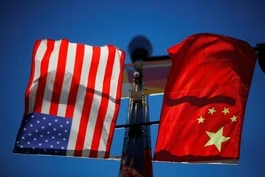
NewAI, trade, Iran and Taiwan top agenda at Trump-Xi summit
Video has Closed Captions
AI, trade, Iran and Taiwan top agenda at Trump-Xi summit (5m 9s)
 New
NewHow diesel prices are rippling through the economy
Video has Closed Captions
How the diesel price spike is rippling through nearly every part of the economy (8m 42s)
 New
NewIn a warming climate, should air conditioning be a right?
Video has Closed Captions
In a warming climate, should air conditioning be a right? (8m 10s)
 New
NewJefferson's hair settles questions about Sally Hemings
Video has Closed Captions
Lock of hair settles questions about Thomas Jefferson and Sally Hemings (7m 43s)
 New
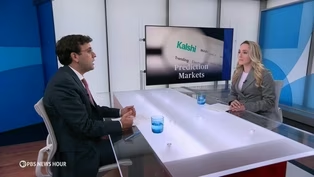
NewKalshi CEO reacts to calls for prediction market regulation
Video has Closed Captions
'We want more guardrails,' Kalshi CEO says as calls grow for prediction market regulation (9m 30s)
 New
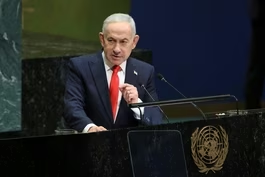
NewNews Wrap: Netanyahu dismisses allegations of genocide
Video has Closed Captions
News Wrap: Netanyahu calls allegations of genocide in Gaza ‘the biggest lie' (5m 36s)
Providing Support for PBS.org
Learn Moreabout PBS online sponsorship
- News and Public Affairs

Today's top journalists discuss Washington's current political events and public affairs.

- News and Public Affairs

FRONTLINE is investigative journalism that questions, explains and changes our world.



 New Episode
 Recently Added
 New Episode




Support for PBS provided by:
Major corporate funding for the PBS News Hour is provided by BDO, BNSF, Consumer Cellular, American Cruise Lines, and Raymond James. Funding for the PBS NewsHour Weekend is provided by...