
Democratic, Republican strategists on direction of parties
Clip: 8/12/2026 | 7m 24sVideo has Closed Captions
Democratic and Republican strategists on the direction of both parties
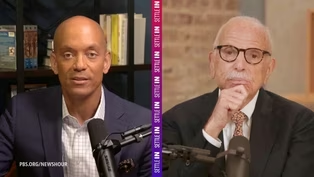
To discuss the primary results for both parties, William Brangham spoke with political strategists from both sides of the aisle. Republican Liam Donovan previously worked for the National Republican Senatorial Committee, and Democrat Joel Payne currently works for the progressive group MoveOn.
Problems playing video? | Closed Captioning Feedback
Problems playing video? | Closed Captioning Feedback
Major corporate funding for the PBS News Hour is provided by BDO, BNSF, Consumer Cellular, American Cruise Lines, and Raymond James. Funding for the PBS NewsHour Weekend is provided by...
Democratic, Republican strategists on direction of parties
Clip: 8/12/2026 | 7m 24sVideo has Closed Captions
To discuss the primary results for both parties, William Brangham spoke with political strategists from both sides of the aisle. Republican Liam Donovan previously worked for the National Republican Senatorial Committee, and Democrat Joel Payne currently works for the progressive group MoveOn.
Problems playing video? | Closed Captioning Feedback
Where to Watch PBS News Hour
PBS News Hour is available to stream on pbs.org and the PBS app.
Providing Support for PBS.org
Learn Moreabout PBS online sponsorshipWILLIAM BRANGHAM: So, for more on last night's results, we are joined now by political strategists from both sides of the aisle.
Republican Liam Donovan previously worked for the National Republican Senatorial Committee.
And Democrat Joel Payne currently works for the progressive group MoveOn.
Gentlemen, thank you both so much for being here.
Joel, to you first.
Let's talk about Wisconsin and the Democratic primary for governor there.
Francesca Hong was up by double digits, I believe it was, in the polls just weeks before this election.
But Crowley ends up squeaking out a win.
When you look at what went down there, how do you assess what happened last night?
JOEL PAYNE, Democratic Strategist: Well, what I see when I look at Wisconsin last night is that the folks who were uncomfortable with Francesca Hong all finally had a candidate to unite around.
Before, in the race, there was the current lieutenant governor, there was the former Lieutenant Governor Mandela Barnes.
There were others in the race.
That field cleared out and it became very clear that Crowley was the alternative to hong.
Hong's numbers were always pretty consistent, in the high 30s, 40 percent, which is about where she landed last night.
It was that undecided vote and that vote that was dispersed among others that never quite came together.
Well, it came together behind David Crowley.
And a lot of that support was in the African American community in big areas like Milwaukee, Madison, Racine, where you see big numbers of African American voters in Wisconsin stacking up.
Crowley was able to do that.
And I think Democrats overall feel more buoyant about their opportunity to defeat Tom Tiffany in November now that Crowley is the nominee, instead of Francesca Hong, because of some of Hong's previous statements and some positions that feel maybe a bit out of the mainstream.
WILLIAM BRANGHAM: I mean, Liam, as Joel is saying, Republicans clearly wanted to run against Hong because of these statements like wanting to cancel Thanksgiving and to perhaps abolish the police.
So they don't have that foil now, and now they have to run against Crowley.
How do you see that unfolding?
LIAM DONOVAN, Republican Strategist: I think, number one, I mean, Francesca Hong was not a great candidate that was very, very ripe for Republicans.
They were certainly rooting for it.
I think, if you're looking at the initial polling, though, Crowley is matching up similarly against Tiffany in the general election.
It is still a tough matchup.
And it's going to be coming down to I think the environment and how Crowley shows me -- this is a guy who not in the race a month ago, so how he shows on the campaign trail, very impressive comeback.
I think, to Joel's point, the collective action problem that Democrats managed to solve, I think they saw the race flash before their eyes with the experience in Michigan.
And so the way that Hong comported herself on that past week prompted the governor to go out and do a full-court press.
And so I think it the establishment sort of won that battle.
But if you look at the war that played out across the country last night, the establishment is taking on the chin in places like Connecticut, in places like Minnesota.
And so I think there is still a lot of this sort of green Tea Party yet to come in this cycle.
WILLIAM BRANGHAM: That's right.
Joel, let's switch to the Minnesota Senate primary.
And as Liam is saying, progressive Dems took it on the change in there.
But they did score this win in Minnesota with Lieutenant Governor Peggy Flanagan beating Congresswoman Angie Craig by double digits.
How much energy do you think is in the Democratic Party right now on this progressive wing, that side of the party?
JOEL PAYNE: Look, I think for sure the energy, the kind of guaranteed energy that you really want at your back going into an election cycle, it is certainly coming from the left flank of the party.
Some of that is frustration with the establishment, both in the Democrat and the Republican Party.
And then some of it is just because of new fresh ideas and fresh candidates.
Peggy Flanagan would be a historic candidate.
She'd be the first woman Native American in the United States Senate.
And I think an issue that really took center stage in Minnesota was ICE.
Of course, Minnesota was ground zero of some of the biggest conflagrations between ICE and between citizens over the last year.
That was a very prominent issue here.
Peggy Flanagan talked about a kind of a maximalist approach to abolishing ICE, Angie Craig a little bit more nuanced, and I think ultimately that was part of the storyline and part of the soundtrack as to why Flanagan was able to beat Craig by a pretty impressive number.
I mean, a 20-point spread in a race like that, that is pretty significant, and I think just adds to the momentum behind the progressive wing of the party.
WILLIAM BRANGHAM: Liam, in the in that same state, for the -- in the Republican gubernatorial primary, Republican Lisa Demuth beat Mike Lindell, the famous MyPillow guy, longtime Trump ally, famous for all of his election-denying shenanigans.
He is one of a handful of these Trump-backed candidates that have not fared, seemingly because Republican voters get a little bit nervous about how they might fare statewide.
How do you see how that one played out?
LIAM DONOVAN: I think Mike Lindell has become kind of a sideshow and a punchline in a lot of ways.
And so, irrespective of the president's support, I think that was pretty clear to the voters of Minnesota.
But I think this has been a state that should have shifted toward Republicans in the Trump era, and for a lot of reasons hasn't.
Part of that has been putting up the right kind of candidates.
So getting some -- moving away from the Mike Lindell model and the Royce White move, moving towards people like Demuth, people like Michele Tafoya, who comes from an outsider background, has sort of an apolitical sports entertainment bent, these are the sorts of people that in a neutral environment put these races in play.
And you got to be encouraged.
It's sort of a similar to the Wisconsin dynamic, Democratic voters taking the choice and making the choice that doesn't take a race off the board.
And so that's what Republicans have to hope in Minnesota.
WILLIAM BRANGHAM: Staying with you, Liam, let's talk about South Carolina quickly.
Newly appointed Senator Darline Graham, sister of Lindsey Graham, had the president's full endorsement.
She was already the incumbent, with all the benefits that accrue to them, but she couldn't quite clear this 50 percent mark.
What challenges do you think she's going to face in this run-off?
LIAM DONOVAN: I think the biggest issue is, Ralph Norman comes in with the ability to self-fund.
So, in an abbreviated timetable where her name residual name I.D.
just being a Graham is good, but, remember, Lindsey Graham has always faced primary challenges in his previous races.
Just most recently, I think there was something like a third of the electorate that voted for an alternative candidate.
So the challenge for Norman will be to spend enough money to consolidate the people who are not sold on another Graham.
The good news is that Darline Graham has the president's backing.
And the other piece is, the president is not so fond of Ralph Norman.
Despite Norman being a strong backer of the president and would back his agenda, he backed Nikki Haley in a way that the president and the White House don't like.
So the idea is I think that the Republican allied groups coming in her favor.
You're seeing some consolidation.
Senator Tim Scott coming out for her today.
So we will see if the party aligns behind her.
Either way, that seat stays Republican, and it's going to be a Trump-aligned voice.
But to your question of, does the president's picks, do they succeed, I think that will be an open question, but she's got a good start with that 30-some percent.
WILLIAM BRANGHAM: Liam Donovan and Joel Payne, thank you both so much for being here.
LIAM DONOVAN: Thanks.
 New
NewAndrew Bird takes eclectic compositions to symphony stages
Video has Closed Captions
Andrew Bird takes eclectic compositions to symphony stages (6m 21s)
 New
NewFederal judges describe threats amid attacks from leaders
Video has Closed Captions
Federal judges describe violent threats amid 'dehumanizing attacks' from political leaders (9m 3s)
 New
NewNews Wrap: Trump confirms he was whisked away in Turkey
Video has Closed Captions
News Wrap: Trump confirms he was secretly whisked away from Air Force One in Turkey (6m 30s)
 New
NewPrimaries yield mixed results for moderate, progressive Dems
Video has Closed Captions
Latest primaries yield mixed results for moderate and progressive Democrats (3m 14s)
 New
NewSam Roberts joins Geoff Bennett on 'Settle In'
Video has Closed Captions
Sam Roberts and Geoff Bennett discuss the art of obituary writing on 'Settle In' (4m 25s)
 New
NewSpain's plan to give undocumented migrants legal status
Video has Closed Captions
A look at Spain's plan to give undocumented migrants legal status (8m 7s)
Providing Support for PBS.org
Learn Moreabout PBS online sponsorship New Episode
- News and Public Affairs

Today's top journalists discuss Washington's current political events and public affairs.

- News and Public Affairs

FRONTLINE is investigative journalism that questions, explains and changes our world.
 New Episode
 New Episode
 New Episode
 New Episode
 New Episode
 New Episode
 New Episode

Support for PBS provided by:
Major corporate funding for the PBS News Hour is provided by BDO, BNSF, Consumer Cellular, American Cruise Lines, and Raymond James. Funding for the PBS NewsHour Weekend is provided by...