
September 24, 2026 - PBS News Hour full episode
9/24/2026 | 57m 46sVideo has Closed Captions
September 24, 2026 - PBS News Hour full episode
September 24, 2026 - PBS News Hour full episode
Problems playing video? | Closed Captioning Feedback
Problems playing video? | Closed Captioning Feedback
Major corporate funding for the PBS News Hour is provided by BDO, BNSF, Consumer Cellular, American Cruise Lines, and Raymond James. Funding for the PBS NewsHour Weekend is provided by...
September 24, 2026 - PBS News Hour full episode
9/24/2026 | 57m 46sVideo has Closed Captions
September 24, 2026 - PBS News Hour full episode
Problems playing video? | Closed Captioning Feedback
Where to Watch PBS News Hour
PBS News Hour is available to stream on pbs.org and the PBS app.
Providing Support for PBS.org
Learn Moreabout PBS online sponsorshipAMNA NAWAZ: Good evening.
I'm Amna Nawaz.
GEOFF BENNETT: And I'm Geoff Bennett.
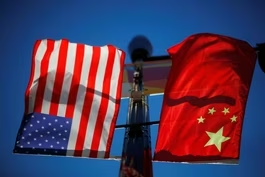
On the "News Hour" tonight: President Trump hosts China's President Xi Jinping and extends the two nations' trade truce, all while a legal battle with journalists hangs over the visit.
AMNA NAWAZ: The price of diesel spikes, hitting Americans' wallets and rippling through nearly every part of the U.S.
economy.
GEOFF BENNETT: And how a lock of hair settles a 200-year-old question about Thomas Jefferson and Sally Hemings.
RICHARD KURIN, Author, "History by a Hair: Thomas Jefferson, Sally Hemings and Solving a 200-Year-Old Mystery": If we get DNA and we can analyze the DNA of contemporary descendants, maybe we can prove this once and for all.
(BREAK) AMNA NAWAZ: Welcome to the "News Hour."
Just after midnight, a federal judge appointed by President Trump ordered the administration to reverse its ban on media outlets CNN, MS NOW, and Politico, ordering the immediate restoration of their access to White House grounds.
The ban had led to an extraordinary days-long standoff after major American broadcast and cable networks united in solidarity, halting all White House TV pool coverage of the president.
This morning, some staff of those three organizations were again not allowed on the grounds.
GEOFF BENNETT: But as the news organizations returned to federal court to seek enforcement of their access, CNN and MS NOW correspondents were readmitted to the White House and back on the air.
Politico reporters were also allowed back in.
That drama played out during much of the public portion of the first visit by a Chinese leader to Washington in more than 10 years.
President Trump hosted Xi Jinping, welcoming him with the military review on the South Lawn.
The pair held two meetings and, while the status of the press pool was still in doubt, delivered remarks.
Now, all of this was captured by the White House and other organizations, and we at the "News Hour" are not showing that video because the television news pool, the network rotation that independently records and distributes video of the president, has yet to be reactivated.
Tonight, Mr.
Trump and the first lady will host a state dinner.
And covering the summit is our Nick Schifrin.
So, Nick, what is on the agenda?
NICK SCHIFRIN: As always, Geoff, between the U.S.
and China, the agenda is topped by trade technology in Taiwan and this year Iran.
So let's do trade and technology first.
The U.S.
and China have agreed to extend what they call a trade truce.
The U.S.
will not raise tariffs on Beijing, and Beijing will continue to allow the export of rare earth magnets.
That's essential for everything from cell phones to electric vehicles to F-35s.
China has a near monopoly on heavy rare earths and rare earth magnets.
U.S.
officials also say they're considering narrow tariff reductions in what they call non-strategic sectors, things like fireworks and low-end consumer products.
Now, on technology, Beijing long complains about American export controls on semiconductors.
U.S.
officials tell me there is no interest in easing that, but there is interest in discussing artificial intelligence.
The U.S.
and China are launching the U.S.
China-AI Dialogue.
And Treasury Secretary Scott Bessent is proposing a dedicated communications line to report any national security AI incidents and what he called a kind of list of agreed dangers, things like out-of-control models, terrorists using AI for cyberattacks or making bioweapons.
Today, Xi Jinping did suggest that cooperation over AI was possible.
He said -- quote -- "We have both the capability and responsibility to develop and manage AI for good and ensure that the development of AI is always under human control and serves the well-being of the people."
In 2024, Geoff, Xi and President Biden agreed that AI would be excluded from nuclear weapons.
But President Trump has been clear, as he put it at the U.N.
this week: "We're leading AI over China by a lot.
We're going to keep it that way."
Regardless what China talks about when it talks about controlling AI is because it fears AI will imperil the party's control and the party's ability to control information to the people.
GEOFF BENNETT: And, Nick, you also mentioned Taiwan, which is always a topic at these summits.
And, of course, there's the ongoing war in Iran.
NICK SCHIFRIN: Yes, and the two might be combined, Geoff.
So let's do Iran first.
A senior U.S.
official tells me Americans have died in Iranian attacks in the Middle East as a result of Chinese actions.
And the U.S.
would like to see those actions, reportedly targeting assistance, stopped.
On Taiwan, last year, the Trump administration authorized the largest ever arms package to Taiwan and previewed a second package.
But, as of today, that second package has not been announced.
A senior U.S.
official acknowledges that, earlier this year, Beijing raised the possibility of canceling these summits if that second package were announced.
But the senior U.S.
official says the main reason that the president has not authorized that second arms sale is because the U.S.
believes that, if the U.S.
were to send more weapons to its partner Taiwan, China would send more weapons to its partner Iran.
And that is something that the U.S.
does not want to risk during the war with Iran.
GEOFF BENNETT: So, overall, you have both sides here interested in stability?
NICK SCHIFRIN: Yes, what both sides have come up with, this phrase, constructive strategic stability.
What does that mean?
It means that all of these issues we're talking about, technology trade, Taiwan, Iran, won't lead to conflict, won't lead to a larger confrontation.
And both leaders repeated that idea today.
We heard from President Trump, saying -- quote -- "If we focus on our common interests, I'm confident there is much we can achieve throughout history."
And Xi Jinping said: "Achieving the great rejuvenation of the Chinese nation," which, by the way is believed to be reunification with Taiwan, "and making America great again can go hand in hand."
Of course, Geoff, all of that language does not paper over all of these issues we have been talking about.
GEOFF BENNETT: Indeed.
Nick Schifrin, thanks, as always, for this great reporting.
NICK SCHIFRIN: Thank you.
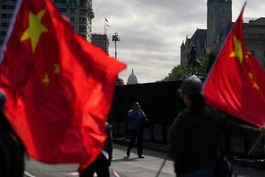
AMNA NAWAZ: For perspective on President Xi's visit to Washington, we turn now to former U.S.
Ambassador to China Nicholas Burns.
He's now our professor of the practice of diplomacy and international relations at Harvard University.
And Samm Sacks, she's a fellow -- senior fellow, rather, at the Institute for America, China, and the Future of Global affairs at Johns Hopkins University.
She's writing a book about data and trust in U.S.-China relations.
Welcome back to you both.
Ambassador Burns, I will begin with you and how this visit began.
We saw President Trump go to greet President Xi on the tarmac at Joint Base Andrews when he arrived.
It was a very rare personal reception by a U.S.
president, who typically receives foreign leaders at the White House.
What did you make of that decision and the message it sends?
NICHOLAS BURNS, Former U.S.
Ambassador to China: Well, Amna, first, I think it's positive that the two are meeting, because this is the most important and most dangerous relationship that the United States has.
And so you have got to meet with Xi Jinping.
I also understand that President Trump wants to be civil and polite.
Americans would want him to be so with a visiting leader.
But this has been an over-the-top visit in terms of the ceremony and the pomp and circumstance.
No American president had gone out to greet a visiting leader since John F. Kennedy in 1962, and he greeted our ally, the British Prime Minister Harold Macmillan.
And if you combine that with the lavish welcome this morning and the state dinner this evening, I don't think that Xi Jinping is going to be swayed by flattery.
He is not a sentimental person.
I have spent a lot of time in meetings with him over the last couple of years.
He's hardheaded and pragmatic, and he's very cynical about the United States.
And his overall strategy is to undermine the United States.
So I don't get why President Trump thinks that this kind of praise -- President Trump said today, we have a great relationship with China.
We actually don't.
We have a very competitive relationship with China.
And, Amna, there's an unwritten rule in American diplomacy that we ought to be nicer to our friends and allies than we are to our adversaries.
There's another leader in the United States this week, Prime Minister Sanae Takaichi of Japan.
She's a true ally of the United States.
I would have rather seen a state dinner for her and a meeting with President Xi Jinping to show him that we value our allies, Japan, Canada, our NATO allies, more than we do, in terms of praise, the Chinese leadership.
AMNA NAWAZ: Samm Sacks, jump in here, because we should note you go to China often.
You speak Chinese.
How is this reception of President Xi by President Trump, how is that likely to resonate in China?
And do you agree with Nick Burns that President Trump is treating his enemies or adversaries better than he treats U.S.
allies?
SAMM SACKS, Johns Hopkins School of Advanced International Studies: I was in China for much of July.
And I think going into the summit this week, expectations were very low, particularly when it comes to AI.
Both sides had been focusing more on an AI race than the reality that we both have shared vulnerabilities.
So, until this week, it was unclear whether this would be on the agenda.
Yes, Trump -- President Trump is much cozier with autocrats than he is with like-minded democratic leaders, and that's a problem.
But the reality is, we have to coexist with China to talk about shared vulnerabilities when it comes to new technologies.
And my sense from track twos and other long conversations with Chinese experts is that having a discussion about AI would be - - would be set to fail from the start if the U.S.
went into those conversations insisting on American primacy, insisting on keeping China back.
And so unless we can treat China like a peer, which they are in terms of the AI capabilities, are really shared by the U.S.
and China at the frontier right now, that was going to be a nonstarter for discussion of an area that's critical from a risk standpoint for both sides.
AMNA NAWAZ: Ambassador Burns, let's talk about that AI dialogue that Nick reported on, that mechanism between the U.S.
and China.
How forthcoming do you expect Chinese officials to be if there is concerning or rogue AI behavior that would reach a bar for national security reporting?
Do you trust that would be shared with the U.S.?
NICHOLAS BURNS: Well, first, I think it's important that the United States and China have a channel of communications on AI and other technologies at a very high level.
I was with President Biden in his last summit meeting with President Xi nearly two years ago.
And President Biden was able to convince President Xi to say publicly that human beings should remain in control of nuclear weapons, not AI systems.
That was an important development.
Scott Bessent, the treasury secretary, said the other day that he thought a channel was important.
We don't want -- neither country wants to see a terrorist group use AI to build a biological weapon.
So I think there are rudimentary things we can do.
The question I have about the Chinese is, their track record is not very good about being forthcoming.
When I was ambassador, there were several crises, you remember, Amna, the balloon incident or Speaker Pelosi's visit, when, frankly, we couldn't get the Chinese on the phone.
So the question is, if we establish a channel -- and I'm in favor of it, as Samm says, but we got to make sure that the Chinese actually show up and deliver and report on these incidents as they occur.
AMNA NAWAZ: Samm, before we let you go, I want to ask you about Taiwan and how they are watching this summit as well, because we have heard President Trump in the past call arms sales to Taiwan a very good negotiating chip with Tina -- China, rather.
And we saw the U.S.
pause those weapons sales to Taiwan after the May summit back in Beijing.
Should Taiwan be worried about the U.S.
softening its support?
SAMM SACKS: A big question going into this meeting is, will Trump cave to Xi Jinping and upend longstanding U.S.
policy by declaring that he opposes Taiwanese independence?
So far, I have not seen indication that he is going to change the status quo.
But what we have seen, which is very worrying, is a violation of U.S.
policy not to use arms sales -- not to consult with Beijing on arms sales to Taiwan.
And so Trump's comments that that package would be a good bargaining chip is not only worrying, but it's a violation of policy.
Now, it is important to keep in mind that the $11 billion record arms sale to Taiwan did go through, but now we have to see is he is going to continue to dangle this with future pauses on upcoming sales.
AMNA NAWAZ: Ambassador Burns, we have got about 30 seconds left.
I will give you the last word on this issue.
Should Taiwan be worried?
NICHOLAS BURNS: Yes, I think so, because President Trump is clearly negotiating with Xi Jinping.
The Chinese have now effectively intimidated the United States on the Taiwan arms sales.
If the president went forward today, the Chinese would likely cancel the November and December meetings planned between the two leaders.
I think he -- I think the president, our president, is pulling too many punches.
He hasn't raised Taiwan effectively.
He hasn't raised an issue you mentioned, Amna, Chinese support for Iran and for Russia in the Ukraine war.
So I think the policy is too weak right now.
We need to be truth-tellers with the Chinese, and I think they will respect us more if we're stronger at the negotiating table.
AMNA NAWAZ: All right, we will have to leave it there for now.
Samm Sacks, former Ambassador Nick Burns, thank you both for joining us.
NICHOLAS BURNS: Thank you.
GEOFF BENNETT: We start today's other headlines at the U.N.
General Assembly.
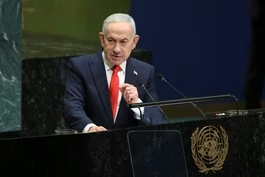
Israel's Prime Minister Benjamin Netanyahu delivered a fiery speech, during which he dismissed allegations of genocide in Gaza as the biggest lie of the century.
And he said attacking Iran was, as he put it, one of the easiest decisions he's ever had to make.
But many delegates did not hear those words directly.
MAN: I request an order in the hall, please.
GEOFF BENNETT: Dozens walked out as the prime minister started his speech.
He called those who left moral cowards, adding that Israel's military actions have actually helped keep them safe.
BENJAMIN NETANYAHU, Israeli Prime Minister: In defending itself, Israel is also -- also defending many of the countries whose delegates just left this hall.
It's hard to imagine more mind-blowing hypocrisy, but that's exactly what it is.
GEOFF BENNETT: Earlier today, Palestinian leader Mahmoud Abbas renewed his call for a two-state solution in prerecorded remarks.
The 90-year-old was unable to attend in person after the Trump administration denied him a visa.
In his speech, Abbas accused Israel of carrying out what he called a genocidal war against the Palestinians.
Israel's Ambassador to the U.S.
Michael Leiter says his son remains in critical condition after officials say a Palestinian man rammed his car into a military checkpoint in the occupied West Bank yesterday.
The suspect was later shot dead.
Speaking from the hospital, Leiter thanked doctors caring for his son Neria who is a reservist in the Israeli military.
YECHIEL LEITER, Israeli Ambassador to the United States: He saved my son's life.
He's still hanging in the balance.
But the professionals here at Shaare Zedek stabilized the situation.
And hopefully they're going to see him through.
GEOFF BENNETT: Leiter's older son, who also served, was killed during the first months of the Israeli war in Gaza.
The West Bank has experienced a surge in violence in recent weeks.
Turning now to Ukraine, officials say at least eight people were killed in the latest barrage of Russian drones and missiles.
In Ukraine's Northeastern Kharkiv region, strikes killed at least six farmworkers, while an attack on this neighborhood in the capital, Kyiv, killed a man and woman.
Those blasts also knocked out power and caused homes to crumble.
But residents say they're determined to carry on even with another harsh winter on the horizon.
LIUBOV PAZUK, Kyiv, Ukraine, Resident (through translator): We know how to make a we know how to make a fire.
We will not starve and we will not freeze either.
The most important thing is that our people continue to believe that what matters most to us is our land, the land beneath our feet.
GEOFF BENNETT: Last week, the U.N.
said that more Ukrainian civilians have been killed so far this year than in all of 2025.
Tropical Storm Nolo is strengthening south of Hawaii as it bears down on the Big Island with the potential for life-threatening floods.
Nolo is forecast to become a major hurricane as it approaches Hawaii, before turning west this weekend.
Schools and most government offices on the Big Island are closed through tomorrow, as Nolo is expected to dump as much as 35 inches of rain.
Meantime, tens of millions along the East Coast are starting to feel the effects of a massive nor'easter offshore.
The coastal storm is expected to bring flooding, powerful wind gusts, and heavy rain from the mid-Atlantic to New England in the days ahead.
Election officials across Texas say they are scrambling to clear a massive backlog of voter registration applications caused by an error at the state level just as counties are preparing for voting in the midterm elections.
State officials have not publicly explained exactly what went wrong, but local election officials say the problem left large numbers of registration applications unprocessed and may have prevented some eligible Texans from voting in the state's March primary.
County offices are now racing to process those applications ahead of the November election, adding another challenge for election administrators as voting gets under way across the country.
In Iowa, President Trump's lawyers say they will appeal a judge's decision to throw out the president's lawsuit against The Des Moines Register and its former pollster Ann Selzer.
Mr.
Trump filed a lawsuit in 2024, claiming the paper deliberately misled consumers by publishing poll results that he claimed were meant to hurt him and help Democrats.
The judge called those claims faulty, adding that the coverage was constitutionally protected political speech.
The paper's parent company, USA Today, called the dismissal a -- quote -- "victory for the First Amendment."
Mortgage rates are now above 7 percent for the first time since early last year.
Mortgage giant Freddie Mac said today that the average 30-year fixed rate mortgage is 7.03 percent.
Rates were heading below 6 percent earlier this year, but have been rising steadily since the start of the Iran war.
Meantime, on Wall Street today, stocks ended little changed.
The Dow Jones industrial average slipped about 160 points.
The Nasdaq rose just three points, so basically flat, and the S&P 500 was also virtually unchanged.
Still to come on the "News Hour": we speak with the CEO of Kalshi, one of the largest prediction markets; as extreme heat becomes more common, a new question, is access to air conditioning a right?
; and what a lock of hair confirms about President Thomas Jefferson's family tree.
AMNA NAWAZ: A rapid surge in the price of diesel fuel is straining businesses and threatening to raise costs across the economy.
GEOFF BENNETT: And it's also putting pressure on the president to respond to higher prices at the pump, including through a diesel export ban that some Republican lawmakers are pushing ahead of the November midterm elections.
William Brangham has the story.
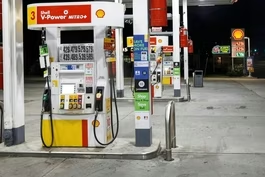
WILLIAM BRANGHAM: The cost of diesel is now well above $6 a gallon.
That is higher than we have seen in many years, even after adjusting for inflation.
A number of factors are driving this spike, and we will talk about them in a moment.
But, first, let's hear from some Americans who are feeling this pain firsthand.
STEVE TURNER, Farmer: Steve Turner.
I am a farmer here in Illinois, in West Central Illinois, located about 45 miles northwest of Springfield.
MORGAN SANSHUCK, Owner, The Boyz Rentals: Morgan Sanshuck.
I'm the primary owner and CEO of The Boyz Rentals.
We're a construction equipment rental company in Wheat Ridge, Colorado.
JILLY STEPHENS, CEO, City Harvest: My name's Jilly Stephens.
I'm the CEO of City Harvest in New York City.
City Harvest is a food rescue organization.
We capture really great food that would otherwise go to waste, and we deliver it to about 450 soup kitchens and food pantries in the five boroughs.
JOHN BOYD, Founder, National Black Farmers Association: John Boyd, a fourth-generation farmer and founder and president of the National Black Farmers Association.
TIM POLLOCK, President, California Trucking Association: Tim Pollock.
I'm president of California Trucking Association For 2026.
I am also the president of CPS Express, our asset-based trucking company.
STEVE TURNER: We're in the harvest.
We have started harvest.
That is a high-demand time.
And when we see these historically high prices, it HAS really shaken us right now.
MORGAN SANSHUCK: They have been skyrocketing, and so much so we can't keep up with how fast they have been climbing.
Overall, the entire operating cost has over doubled just in direct relation to the price of diesel.
JILLY STEPHENS: We have a fleet of 23 trucks that we use to deliver that food to a network of over 400 food pantries.
Those costs are about 15 percent higher than they were last year.
And we estimate that that could add about $100,000 to our budget that we weren't expecting to pay.
JOHN BOYD: Market price is $5 dollars a bushel, and I'm having to pay an increase at the pump of relatively 50 percent.
I'm robbing Peter to pay Paul because I don't have the money.
And I'm letting some other bills go, trying to put diesel fuel in my combine.
TIM POLLOCK: You know, we negotiate with our customers and we ask for emergency help.
We did have fuel surcharges in place.
It doesn't make up all the fuel, especially when it's astronomically high like it is.
STEVE TURNER: Any farmer out here, when we had to put budgets together in January, and I can tell you there was nothing budgeted in there or nobody could have seen this increase.
And it's nothing uncommon for a farmer out here to use 10,000 or 20,000 gallons of diesel fuel, in some larger operations more.
So do your math right there.
MORGAN SANSHUCK: We have been trying to hold out for as long as possible not raising prices, hoping that things are going to kind of come back down, hoping it was just a fluke surge and that everything would normalize.
But effective Sunday, we're having to raise prices.
We were forced into it.
We were losing money uncontrollably.
JOHN BOYD: This diesel fuel surge is just one thing on top of a rippling effect that we have been dealing with since this administration came in, Trump tariffs.
When the prices plummeted, we never recouped.
The Iran war, and fertilizer prices went through the roof.
All of those decisions haven't been made by farmers.
But we're the guys, the first in line that are paying for this administration's mistakes.
JILLY STEPHENS: We have a goal to rescue and deliver 100 million pounds of food this year.
Those calculations are pretty precise.
And you know what?
We always plan for a little bit of fluctuation, not to this degree and not in a sustained way.
STEVE TURNER: This is a long road, it looks like, ahead.
And you know what?
Even if this could all end tomorrow, which it won't, it's going to take time to recover.
WILLIAM BRANGHAM: So for more on all of this, we are joined by Bob McNally.
He's founder and president of the consulting firm Rapidan Energy and he was a former White House energy adviser to President George W. Bush.
Bob, thank you so much for being here.
We just heard from these people who are really struggling to make this math work.
Diesel prices, I believe they're up roughly 75 percent year over year.
Generally speaking, what is driving this spike?
BOB MCNALLY, President, Rapidan Energy Group: Well, William, first, it's important to understand that the price of diesel we pay at the pump, or gasoline, for that matter, is set in a global market to which we are very much connected in the United States.
And that means that a disruption anywhere on the globe in distillate markets, diesel markets, gasoline and crude transmits a price spike everywhere, including here, including in our farm country as well.
And so this really -- it's sort of like a tax increase.
It's a sudden, sharp, unavoidable tax increase you have no choice but to pay, is really coming from disruptions in first the Arabian Gulf area due to the war with Iran, and secondly and importantly, with Russia.
Russia was the largest diesel exporter after the United States and the world.
And so Russia has had to ban its exports of diesel because the Ukrainians have been successful at destroying the refineries.
So disruptions over there have led to the price increases here.
WILLIAM BRANGHAM: As we heard some hint of what this is really all about, but for people who are not familiar with diesel's centrality in the American economy, remind us, why is it so critical?
BOB MCNALLY: You know, diesel is the real workhorse of the economy, the workhorse fuel.
We think of gasoline.
We pump gasoline.
Gasoline gets more political attention.
But gasoline is about one thing, transportation.
Distillate's about transportation, farm equipment, trains, boats, planes, but it's also about other things.
It's about power generation.
It's about home heating.
It is about defense and mining.
Distillate is used all throughout the economy.
It's a much more important fuel when it comes to just about everything we do and produce in the country.
And for that reason, it's important.
It's important for the Federal Reserve and macroeconomists as an inflation risk and so forth.
So distillate's the real workhorse of the economy.
WILLIAM BRANGHAM: As you know, we produce more diesel here than we actually consume, so some of it usually gets exported.
After denying for a very long time that they would ever consider this, the president reversed himself recently and suggested that he might ban the export of diesel, potentially as a way to bring down costs.
One, do you think that would work?
I mean, some people have suggested that could boomerang.
And how would that actually play out if it were enacted?
BOB MCNALLY: Yes, I don't know a single oil economist or energy expert, a Republican, Democrat, inside the administration or out, who thinks that export restrictions are a good idea.
They would work only for a few weeks in certain parts of the country.
If the president followed through on his a suggestion to ban the export of distillate, we would see for a few weeks prices collapse at the pump by many dimes a gallon in Texas, Louisiana, maybe the Lower Midwest, maybe somewhat... WILLIAM BRANGHAM: So that's significant.
BOB MCNALLY: It would be.
You would have a sharp - - because you would suddenly trap -- we export -- about 30 to 40 percent of the distillate that's made in the Gulf Coast, our refining sector, is exported.
If you suddenly banned that, you would have all that volume that would have to be stored and would sort of flood into the country, and that would lower prices for a few weeks.
But then the prices would rise again because refiners would reduce their production of diesel.
They just lost 20, 25, 30, 40 percent of demand.
Also, remember what I said about global prices.
Prices around the world for diesel will skyrocket.
The rest of the world will feel betrayed after Russia banned and other countries have had it disrupted.
Now the United States, the world's largest diesel exporter, cuts everybody off?
The price of the oil around the world will skyrocket.
And if you're in the Northeast of the United States or you're in Alaska, your price at the pump depends on those imported prices.
So, eventually, after a few weeks, everybody will see higher oil prices.
It's for that reason that just about every oil analyst I'm aware of discourages those kind of export restrictions.
They only work for a very short period of time.
Then you're worse off afterwards.
WILLIAM BRANGHAM: Bob McNally, Rapidan Energy, thank you so much for being here.
BOB MCNALLY: Thank you.
AMNA NAWAZ: Well, fall temperatures are finally cooling down for much of the U.S., but this past season was yet another reminder that the climate is changing.
2026 was the warmest summer on record in the contiguous United States.
Stephanie Sy reports on how some cities are considering whether residents should have a right to air conditioning.
It's part of our ongoing series Tipping Point.
STEPHANIE SY: This past July, as the nation celebrated a milestone Independence Day, New York City was sweltering under a record-breaking heat wave.
BRIANNA STYLES, Brooklyn Tenant: It was humid, hot, moist.
I felt like my apartment was melting.
STEPHANIE SY: Twenty-two-year-old Brianna Styles and her toddler suffered through it without air conditioning.
At one point, her Brooklyn apartment got so hot, she said the paint started peeling.
BRIANNA STYLES: The first day, we had to thug it out.
We were laying in this apartment.
I was doing TikTok hacks.
MAN: Absorb some of the heat.
BRIANNA STYLES: I was trying everything to cool us down.
I kept putting him in the bathtub with cold water, cold water.
But then the day after, I had some family friends help me.
They allowed me to stay in their home.
It kind of hurt me.
I'm like, oh, yes it's really hot.
I can't provide my son with cold air.
STEPHANIE SY: Unemployed and unable to afford a window A.C.
unit in her city subsidized apartment, Styles is among the nearly 10 percent of New Yorkers without access to A.C.
in their homes.
In some lower-income areas of the city, almost a quarter of households go without.
BRIANNA STYLES: My son had a really bad heat rash.
And not only that, he was also getting eaten by mosquitoes.
And I am waking up and I'm seeing my son with almost 100 bites every morning, and I didn't know what to do.
And it's like, I can't just close the windows.
And it was just -- it was very hard.
It was very hard.
LINCOLN RESTLER, New York City Council Member: Five hundred and eighty people die every single year in New York City from extreme heat, and the most common factor among them is that they lack access to cooling in their homes.
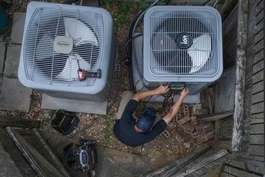
STEPHANIE SY: Starting in 2030, a new law will require New York City landlords to provide cooling systems capable of keeping rooms where tenants sleep at 78 degrees during the peak summer months.
Most tenants will be on the hook for the energy they use, but the city's public housing authority is largely exempt from the cooling mandate.
CALEB SMITH, WE ACT for Environmental Justice: Maybe we are using air conditioning, but we're using it more strategically.
STEPHANIE SY: Caleb Smith is the New York City policy manager for WE ACT for Environmental Justice in Harlem.
Smith says the law addresses New Yorkers' basic needs in a warming world.
Researchers estimate that, by the 2050s, New York City could have eight times as many days at or above 95 degrees due to climate change.
CALEB SMITH: If there's no baseline for what is acceptable in our housing for extreme heat, then it's always considered to be a luxury.
We already have requirements for heating because we know that no one should be freezing in their home.
And the same should apply when we're facing temperatures that have a heat index of 100, 105 degrees.
STEPHANIE SY: New York City is not alone in taking action.
Cities like Phoenix, New Orleans, and Dallas have cooling requirements on the books.
And, this summer, both Spokane, Washington, and Houston passed measures, mandating a so-called right to A.C.
for renters.
GRACE WICKERSON, Federation of American Scientists: We see policies popping up all over the country.
STEPHANIE SY: Grace Wickerson studies the intersection of climate and health at the Federation of American Scientists and has tracked the growth in these measures.
GRACE WICKERSON: Chronically high temperatures at night make it harder for you to sleep.
They make your body work harder to circulate blood throughout your system as a cooling strategy.
And all of these stressors compound.
And we're just starting to identify the many ways that heat then leads to heart attacks, kidney failure, and other health impacts that might not be -- quote, unquote -- "heat-related" at first glance, but are actually because we're seeing this compounding exposure work on people's bodies.
STEPHANIE SY: But in New York City, many landlords are against the new requirement.
KENNY BURGOS, CEO, New York Apartment Association: Putting the burden on property owners is not the right way the government should be approaching this.
STEPHANIE SY: Kenny Burgos runs the New York Apartment Association, which represents thousands of rent-stabilized property owners in the city.
About 40 percent of New York's housing stock is in this category, where rent increases are restricted by a municipal board.
KENNY BURGOS: New York City building owners and particularly rent-stabilized property owners are operating some of the oldest housing in the city of New York, and they have been running up against just increasing operation costs.
We have seen an explosion in insurance costs.
We have seen property taxes rise.
We have seen water and sewer rates rise year over year.
And now you add in what we call unfunded mandates from the city council, this A.C.
bill.
STEPHANIE SY: Burgos also points to infrastructure concerns, including whether older buildings and the city's electrical grid can handle tens of thousands of new A.C.
units.
Adding A.C.s may also conflict with existing city laws to reduce climate change because they add to carbon emissions.
But advocates argue that a right to A.C.
should be paired with subsidies for more efficient devices and weatherization to reduce the carbon impact.
CALEB SMITH: All of the investment towards energy efficiency means essentially that people use less energy to cool their homes down.
STEPHANIE SY: But paying for that energy can be a big hurdle for tenants.
DIANA HERNANDEZ, Columbia University: The provision of an air conditioning unit is a first step.
It's a necessary step, but it is inadequate.
We do need probably kind of bill supplements, need utility discounts, additional energy assistance.
STEPHANIE SY: Diana Hernandez is a public health professor at Columbia University and co-author of the recent book "Powerless: The People's Struggle for Energy."
Her 2024 research shows that one in five New Yorkers had difficulty paying utility bills.
DIANA HERNANDEZ: In Arizona, 75 percent of indoor deaths are happening in homes that have an air conditioning unit.
So we know that people are dying, not necessarily because they lack air conditioning units, but because they are reluctant to turn those air conditioning units on.
NARRATOR: Summer can mean dangerously high heat.
STEPHANIE SY: Hernandez points to the need to expand supports like the Low Income Home Energy Assistance Program, which has not kept up with inflation.
The Trump administration has proposed cutting the $4 billion program entirely.
DIANA HERNANDEZ: People will face the risk of a disconnection.
And in many states, there aren't many protections, particularly in hot weather months.
STEPHANIE SY: Brooklyn tenant Brianna Styles applied to a state program for a free A.C.
this summer, but never heard back.
But if she were able to get a unit, she knows it would increase her electric bill.
BRIANNA STYLES: That's something I have to worry about and 100 percent that's something I need.
My child cannot be in the boiling heat.
Like, he's a kid, and he shouldn't have to go through that.
STEPHANIE SY: Would it also be a sacrifice?
Would it keep you from being able to pay for other things?
BRIANNA STYLES: A hundred percent, but nothing is worth my son going through any type of pain.
STEPHANIE SY: In New York City, summer is officially over, but extreme weather isn't going anywhere.
For the "PBS News Hour," I'm Stephanie Sy.
GEOFF BENNETT: As prediction markets continue to grow, they're drawing attention in Washington, D.C., and across the country.
AMNA NAWAZ: Companies like Kalshi and Polymarket allow people to trade contracts tied to the outcomes of real-world events, including elections.
But the call for regulation is growing louder.
Our White House correspondent, Liz Landers, has more.
LIZ LANDERS: Prediction markets are regulated by the Commodity Futures Trading Commission and can operate nationwide.
But many argue they should be subject to state gambling laws.
Members of Congress have also called for guardrails as the industry expands.
For perspective from one of the largest prediction market platforms, I'm joined by Kalshi CEO Tarek Mansour.
Welcome.
Thank you for joining us.
TAREK MANSOUR, Co-Founder, Kalshi: Thanks for having me.
I'm excited to be here.
LIZ LANDERS: Explain to us, what does Kalshi do?
What is a prediction market?
TAREK MANSOUR: So prediction markets is a financial market.
It functions like any other traditional financial market, whether it's on traditional grain futures, commodity futures, interest rate swaps, the stock market, right?
It matches buyers and sellers to basically trade something.
In the case of prediction markets, it's trading a broader set of things.
It's applying the same traditional financial market structure, but on a much wider set of topics.
And, in our case, it's like weather, it's politics, it's elections, it's sports, it's economics, AI, tech, all these topics that people are now exposed to interested in have economic risks related to it and would like to forecast and have difference of opinions on.
LIZ LANDERS: You all have been under scrutiny for how your marketplace is set up.
The New York state attorney general sued, Attorney General Letitia James.
And she said at the time in July that: "New York's gambling laws protect children from underage betting and help combat gambling addiction.
No matter what they call themselves, prediction markets like Kalshi are gambling platforms, plain and simple."
They say you are a betting market.
Why are they wrong?
TAREK MANSOUR: An exchange is a place that matches buyers and sellers.
And it's a place that needs a very large diversity of participants that are engaging and competing against each other to figure out the price, promote price discovery, which enables things like people taking a position on something or taking people hedging against something, reducing the economic risk against that thing, right?
And that's the key difference.
That is very different from gambling, where the business model is -- the gambling business model, it's a business model where you're -- the house bets against its customers.
The revenue of the house is equal to the customers' losses.
And that model is a model where the house, what it does over time is, it figures out who wins, people that do smart trading and research, and bans them and figure out the people that lose and figure out how to target them specifically to keep them coming and so on and so forth.
That difference incentive is critical, right?
There, they need to figure out who the losers are and keep them coming, which creates the addiction issues and all these issues that are very important, whereas open financial markets, Kalshi doesn't make more or less money from winners or losers.
When somebody loses, they're losing it, someone else.
It's an open market where people are trading against each other, and that's a key, critical distinction.
LIZ LANDERS: One of the points that she makes in that comment too is the effect on young people.
What do you say to this criticism that it's hurting young people and addicting young people?
TAREK MANSOUR: So, to be clear, there is a -- and this happens.
There's a lot of things going on Twitter and social media and sometimes in the news.
But a lot of these things are not true.
So we don't cater -- the law doesn't let us, and we would never do it, allow minors on the platform.
So we ban minors unequivocally.
We have actually gone beyond what is required from us regulatory-wise, in terms of providing tools for parents to make sure they monitor and make sure that, for example, their kids are not using their I.D.s And these are the ways that kind of minors try to access, whether it's financial platforms, crypto, prediction markets, and so on.
But the risk with any of these financial products is real.
I think that there's a real risk and a real concern, which is when you have a technology that becomes a mass technology.
We have 30 million customers now, right?
I always say this.
There's a lot of upsides.
But at the same time, there's some percentage of activity in any of these platforms, whether big tech, whether prediction markets or financial companies.
There are going to be irresponsible use, right?
And the role of regulation, which Kalshi is very -- has been very forthcoming about -- let's regulate this and figure out the right rules of the road.
LIZ LANDERS: I have heard you say you're pro-regulation, you're a pro-regulation company.
TAREK MANSOUR: Absolutely.
LIZ LANDERS: What does that mean?
TAREK MANSOUR: Well, it means -- when we started the company in 2018, we didn't launch until the general -- for the general public until four years later in '22.
So what were we doing in those four years?
We were actually coming to the federal government and getting regulated proactively before launching our product.
We said, let's get regulated before we do anything, before we launch, before we do anything.
And then, once we get regulated, we basically build the product and launch, and it's been a very successful strategy.
Now, how do we take that to today?
Today, our message to Congress and others is, like with any markets, there's going to be some risks.
We are self-regulating those risks.
So, for example, we ban any markets on war, assassinations, death, things that can create moral hazards.
We have never done them.
We will never do them.
We have a comprehensive customer protection regime to make sure that we're limiting irresponsible use and banning it.
We ban insider trading.
We ban members of Congress and administration from participating in markets they may have influence over.
And we want these to be standard for the entirety of the industry, because we're not the only players.
There's now tens of players in the industry.
And our message is, we want more guardrails, and I think this is what they should look like.
LIZ LANDERS: You talked about the elections.
Kalshi launched a midterms hub a few months ago, which you all dubbed the wisdom of the crowds without the bias.
Sports prediction markets is one thing, but are you concerned about trading on elections and candidates?
And is this better than polling?
TAREK MANSOUR: So the answer is, the data shows that it is, right, very clearly is.
And so what is the purpose of these markets, why we're so excited about these markets is, this is the first time we have a metric that is coming from people.
And historically you could have polls, but there's issues with polls.
People sometimes commission polls that they bias the .
They want to -- they reverse-engineer for the story and the narrative they want to tell.
There is -- a lot of the information that comes from a small handful of elites are in D.C., whereas prediction markets is people.
It's millions of people basically with skin in the game predicting what they think is going to happen.
And we're very excited about the midterms hub, because the way we're structuring it and our message is always use it as an alternative or in a complement to all the other data sources.
But what's nice about prediction markets is, the incentive structure is truth.
If you say something that is not super smart, you will probably lose money.
And if you say something that is smart and you're doing research and you're reading about things and you're digging in, you will probably make money over time.
And that's the whole point.
It's in some ways depolarizing the conversation around politics and making it a little bit more truthful.
LIZ LANDERS: I want to ask you.
Donald Trump Jr.
is an adviser to Kalshi.
Are you concerned about that being an ethics concern, because Kalshi is regulated by the CFTC and that is a part of the Trump administration?
TAREK MANSOUR: No, we -- when we got regulated, we actually got regulated in 2020, when we got our exchange license.
And I always say this.
Like, we will work with all administrations.
And when I engage with Congress right now, we're engaging with both sides of the aisle pretty much equally.
I always say, like, this doesn't need to be a partisan issue.
But we should have sensible guardrails to make sure people don't fall off a cliff.
LIZ LANDERS: But what does Donald Trump Jr.
bring to Kalshi?
TAREK MANSOUR: You know, we did it in close to the middle of 2024, and it was really about at the time we were a very small company.
We were, I mean, around 20 people, tiny company.
Nobody knew about us.
We were pretty much a small start-up.
And at the time, we were figuring out ways to get our word out about how to use these markets, and it was very hard.
People weren't talking about prediction markets two years ago.
And we're very excited about -- like, we're partnering with like people on Twitter and people that had a big microphone that could talk about these markets and tell people this is an alternative to the polls and you should use them.
And that's why we got very excited about Don, who had a big microphone and was excited about these markets.
And as I always say, we have people on both sides of the aisle that are excited about prediction markets.
They're advisers on our board.
They're investors, they're partners, and so on and so forth.
And we're excited about anyone who's excited about prediction markets.
LIZ LANDERS: I want to ask you about a story that The Wall Street Journal had earlier this week about a series of trades.
There were about a million of them that were in one market on your platform and they were all $5,500.
Do you believe that that is wash trading, which is a practice that amplifies the quantity of trades on a platform to make it look active?
Were you aware of this?
TAREK MANSOUR: Yes, unequivocally not.
It's not wash trading.
It's actually very typical of exchanges.
Mainly, my message is, don't hear all the rumors that you find on X. And there's people that are self-interested in some ways, some competitors and others that are promoting a variety of different things.
But, no, that this is not wash trading.
There's no artificial inflating or other.
It gets a little bit technical, but people that have sort of run exchanges understand this.
What exchanges do when they're developing new products is, they provide small incentives for what we call liquidity providers, people that go out there and provide the supply of liquidity to get going, to get the marketplace going.
And that's what we do.
And this comes with minimum obligations.
It says you have to provide a minimum size and a maximum spread.
So you have to provide - - you will have to always be there so that when someone wants to buy, you're there to sell, and when someone wants to sell, you're there to buy.
That fosters liquidity and makes sure that people can do the things that they're supposed to do.
And so sometimes with those types of liquidity conditions or requirements, people basically trade against those with fixed size.
It's like a fixed slot, which is very common in like the stock market, very common in traditional commodities markets.
Some people misunderstand them.
Some people were, I think, intentionally misleading.
We can't control what everyone says on Twitter.
LIZ LANDERS: Tarek, thank you so much for your time.
I appreciate it.
TAREK MANSOUR: Thanks so much for having me.
GEOFF BENNETT: For more than two centuries, a question has hung over the legacy of Thomas Jefferson: Did the nation's third president father children with Sally Hemings, the woman he enslaved at Monticello?
Historians have long treated Jefferson's paternity of Hemings' children as established.
Now a remarkable scientific investigation is offering what researchers say is the most conclusive answer yet.
It began with a single strand of hair pressed between the pages of Jefferson's Bible at the Smithsonian.
That discovery launched a 15-year investigation involving DNA scientists, historians, genealogists, and descendants of both Jefferson and Hemings.
The story of that investigation and what it reveals is told in the new book "History by a Hair: Thomas Jefferson, Sally Hemings and Solving a 200-Year-Old Mystery."
Its author, Richard Kurin, is a distinguished scholar and ambassador at large at the Smithsonian Institution.
We're also joined by Jefferson and Hemings' descendants David Miller and Clara Lee-Nutt.
Welcome to the "News Hour."
CLARA LEE-NUTT, Descendant of Thomas Jefferson: Thank you.
RICHARD KURIN, Author: Thomas Jefferson, Sally Hemings and Solving a 200-Year-Old Mystery": Good to be here.
GEOFF BENNETT: And, Richard, historians had largely accepted that Thomas Jefferson fathered Sally Hemings' children.
What remained unanswered for you that led you on this 15-year journey?
RICHARD KURIN: Well, there were still people who questioned it, a few historians, members of the family and so on.
And I think the idea of being able to firmly establish that was very appealing for many people.
GEOFF BENNETT: And how did this all come together?
RICHARD KURIN: Well, it was a hair in the Bible, and we discovered it while we were conserving the Bible, a national treasure, at the Smithsonian.
And I said, wait.
If that's a hair in Jefferson's Bible, maybe we can get DNA from it.
If we get DNA and we can analyze the DNA of contemporary descendants, maybe we could prove this once and for all.
GEOFF BENNETT: And, of course, 200-year-old hair doesn't strike most people as an obvious source of a of a usable genome.
How do you know that it was actually Thomas Jefferson's strand of hair?
RICHARD KURIN: Well, it actually turned out, Geoff, that the Bible hair wasn't Thomas Jefferson's, but another hair was, and that was kept in a packet at Monticello by the Thomas Jefferson Foundation.
And when we sampled that, we found that it had the Y chromosome of the Jefferson males family.
It had the mitochondrial DNA of Thomas Jefferson's mother, which we found matched a woman living in Florida, seven generations of females.
So it could only be someone -- the hair of somebody who had Thomas Jefferson as a father and Thomas Jefferson's mother.
It had to be Thomas Jefferson's.
The provenance was also great.
This was a hair, and I don't make this up, that was clipped from Thomas Jefferson's head on July 4, 1826, the day he died.
And we had historical provenance to show that.
GEOFF BENNETT: And, Clara, in many ways, you didn't need the DNA to know who you were.
You grew up knowing that you were a descendant of Jefferson and Hemings.
Still, what did it feel like to have this confirmed by DNA evidence?
CLARA LEE-NUTT: Well, to me, it was more about my father being validated than being tied to Jefferson.
I lost my father when I was 10.
Some of my very precious memories of him are speaking about Jefferson, hearing him talking about Jefferson with his siblings, and then losing him at the age of 10 and having not asked enough questions.
So this was a fulfillment of so many -- I met so many people who could answer some of the questions for me.
I have met cousins who knew my father, and it's just been wonderful.
It's just been a wonderful moment.
GEOFF BENNETT: When you were 12, as I understand it, you visited Monticello.
CLARA LEE-NUTT: Oh, yes.
GEOFF BENNETT: And you asked, "Tell me where Sally Hemings slept."
And what was the response that you got?
CLARA LEE-NUTT: Oh, my goodness.
Well, and the thing is, I had prepared for this trip.
My father had passed two years prior to my trip.
And, in my mind, I'm like, oh, my gosh, I'm going to go to this place that my father spoke of, and they're going to know me.
I'm going to go in there and I will -- there will be something familiar, something that I can hold on to.
And I was naive.
So I go through there.
And, of course, I'm dressed for the occasion.
I have on my polyester bell bottoms.
I have my Afro puffs, my halter.
What could possibly go wrong?
So I'm walking through.
And I -- they weren't mentioning Sally at all.
And I finally said: "Well, where did Sally Hemings sleep?"
And the tour guide turned and just said: "There is no reason to believe that woman" -- she wouldn't even say Sally's name -- "that that woman ever set foot in this house."
And there was a collective groan from my classmates, and it just -- it was like she put nails in my father's coffin that day.
GEOFF BENNETT: David, you have said that you already had believed that Jefferson fathered Sally Hemings' children.
So what do these results mean to you?
DAVID MILLER, Descendant of Thomas Jefferson: Geoff, to me, it's very important that we are a family and that we can now acknowledge and accept the entire family, that that's what really it boils down to for me.
And the bonds I have made just this weekend and prior with Clara and some of the other cousins has just been a wonderful experience.
GEOFF BENNETT: You refer to them as cousins?
DAVID MILLER: Oh, yes.
GEOFF BENNETT: Yes.
It's interesting, because this history is so often told as two separate branches of the Jefferson family.
But to hear you describe it as one and the same is striking.
DAVID MILLER: Yes, and I'm speaking just for myself, to be clear.
But there are many in the -- I call it his first family, if you will, just like a first wife, second wife thing, many that feel the same way.
There are many that don't feel that way.
So... GEOFF BENNETT: David, for those family members who don't accept this evidence and don't accept this history, what do you think their responsibility is?
DAVID MILLER: I think their responsibility is to face up to science, number one.
You can argue lore, you can argue what somebody else says may or may not be correct, but science is science.
And when you accept that, it leads pretty much down one path.
GEOFF BENNETT: What does this discovery, this confirmation?
What does it mean for our overall understanding of Thomas Jefferson, who he was, and his involvement in the practice of slavery?
RICHARD KURIN: Well, look, Thomas Jefferson wrote the most famous phrase probably in American history, all men are created equal, they're entitled to these rights, and that's become a national mission statement.
But we fell short of that even from our founding.
And I think our national quest is the perfection of that aspiration.
It's complicated.
And, look, we had a civil war over slavery; 700,000 people died.
And I think the lesson for me in all of this has been not to disparage people or whatever, but recognize our country has a complicated history.
We have overcome a lot of challenges.
We still have some things to face, but, altogether, we're one American family.
The issue of Jefferson's progeny, whether through his wife, Martha Wayles, or through Sally Hemings, they're all Americans.
They're part of one American family.
We're a complicated family, and we share a future together.
So we better figure out how to reconcile those differences.
GEOFF BENNETT: Clara Lee-Nutt, David Miller, Richard Kurin.
The book is "History by a Hair: Thomas Jefferson, Sally Hemings and Solving a 200-Year-Old Mystery."
Thank you all.
RICHARD KURIN: Thank you, Geoff.
CLARA LEE-NUTT: Thanks for having us.
AMNA NAWAZ: And that is the "News Hour" for tonight.
I'm Amna Nawaz.
GEOFF BENNETT: And I'm Geoff Bennett.
For all of us here at the "News Hour," thanks for spending part of your evening with us.
 New
NewAI, trade, Iran and Taiwan top agenda at Trump-Xi summit
Video has Closed Captions
AI, trade, Iran and Taiwan top agenda at Trump-Xi summit (5m 9s)
 New
NewExperts analyze what's at stake in the Trump-Xi summit
Video has Closed Captions
Experts analyze what's at stake in the Trump-Xi summit (7m 50s)
 New
NewHow diesel prices are rippling through the economy
Video has Closed Captions
How the diesel price spike is rippling through nearly every part of the economy (8m 42s)
 New
NewIn a warming climate, should air conditioning be a right?
Video has Closed Captions
In a warming climate, should air conditioning be a right? (8m 10s)
 New
NewJefferson's hair settles questions about Sally Hemings
Video has Closed Captions
Lock of hair settles questions about Thomas Jefferson and Sally Hemings (7m 43s)
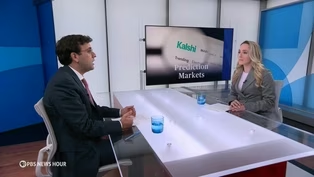 New
NewKalshi CEO reacts to calls for prediction market regulation
Video has Closed Captions
'We want more guardrails,' Kalshi CEO says as calls grow for prediction market regulation (9m 30s)
 New
NewNews Wrap: Netanyahu dismisses allegations of genocide
Video has Closed Captions
News Wrap: Netanyahu calls allegations of genocide in Gaza ‘the biggest lie' (5m 36s)
Providing Support for PBS.org
Learn Moreabout PBS online sponsorship
- News and Public Affairs

Today's top journalists discuss Washington's current political events and public affairs.

- News and Public Affairs

FRONTLINE is investigative journalism that questions, explains and changes our world.



 New Episode
 Recently Added
 New Episode




Support for PBS provided by:
Major corporate funding for the PBS News Hour is provided by BDO, BNSF, Consumer Cellular, American Cruise Lines, and Raymond James. Funding for the PBS NewsHour Weekend is provided by...